Thursday, 30 October 2014

I guess that's the "English Votes for English Laws" issue settled, then


Seat projections for the Westminster 2015 election based on the results of today's IPSOS MORI poll.

Memo to Labour: if you lie (in both senses of the word) with the Tories, be prepared to be treated like Tories.

Tuesday, 28 October 2014

My Windows 8.1 comedy misadventure


On Monday evening, just after 9 o'clock, I decided to finally replace my Windows 7 installation on my main desktop PC with Windows 8.1. I assumed the upgrade process would be relatively straightforward, taking a couple of hours at most and requiring minimal effort on my part other than putting the DVD in the drive and clicking "Next" where necessary. I should add that I had no burning NEED to install Windows 8.1 -- I just fancied a change after all these years, and am one of those people who likes to be running the latest version of any software. I've been running Windows 8.1 on the secondary partition on my MacBook Pro and have had no complaints about it, once Charms and other annoyances have been disabled and Start8 is installed. And besides, Windows 8.x has a nifty file transfer dialogue.

More fool me.


9:30 PM

My problems started when I discovered that, despite Windows 8.1 being a free upgrade available to all Windows 8 owners, I couldn't actually install Windows 8.1 using my Windows 8 license key. That's right, it demands a specific Windows 8.1 key. No problem, I thought -- I'll install Windows 8, then install the Windows 8.1 update afterwards. After all, it's basically just a service pack, right?

More on that later. First, however, a more immediate problem.


10:00 PM

I updated to Windows 8 successfully and found myself with over 100 Windows updates to install... one of which, I assumed, would be the Windows 8.1 update. I promptly elected to install all 100+ updates in one go and sat back to wait for it to do its thing.


10:30 PM

"Failure configuring Windows updates. Reverting changes. Do not turn off your computer".

Oh.

Obviously, the system had decided to crap itself when faced with so many updates at once. No biggie, I thought. I'll wait for it to roll back, then install them in blocks of, oh, say, 20 at a time. Problem solved.

Except not.


00:30 AM

Two hours(ish) later, after several reboots and the same error message continuing to appear, it began to dawn on me that this wasn't going to be plain sailing. Realising that there was nothing for it, I pulled the plug and booted into the recovery menu, intending to make use of the system refresh utility that made its debut with Windows 8.

To explain, you have three options when you do this. The first and least invasive of these is a system restore, which takes you system back to an earlier point in time with a minimum of hassle. This has been a standard feature in Windows for many years now, and I've used it on a few occasions in the past without any problems.

Error message telling me there are no usable system restore points. Strike 1.

The second, more invasive option, is a system refresh, which scrubs all your settings and installed programs but keeps your files intact. Not ideal, but oh well. I decided to try that.

"There was a problem refreshing your PC. No changes were made." Strike 2.

Option three is the nuclear option: what Microsoft calls a reset, which is essentially the equivalent of wiping your entire hard drive and reinstalling from scratch. Microsoft claims this means you'll lose your files, though obviously if, like me, you keep all your files on a secondary hard drive anyway, that's not the case.

"There was a problem resetting your PC. No changes were made." Strike 3.

At this point I realised the whole system was goosed to the point that Windows couldn't even nuke itself, meaning I'd have to do the job for it. By this time, it was approaching...


01:00 AM

Not a problem. I've reinstalled Windows more times and on more computers than I care to remember. It doesn't faze me, and it's not as if there's anything irreplaceable on my C: drive.


01:30 AM

And the process of installing a fresh copy of Windows 8 was straightforward enough. Once I'd got myself into a fresh desktop, I set about downloading the 100+ Windows updates all over again and installing them in chunks.


02:30 AM

Success! Windows was fully updated and ready for action. Only... where was the Windows 8.1 upgrade? There was no download showing up in Windows Update, where you'd logically expect to find it.

A quick visit to Google told me that, contrary to all logic, you do not in fact download the Windows 8.1 update through Windows Update, but rather through the dreaded App Store. OK, then. It was easy enough to find: a big button reading "Update to Windows 8.1 for free." Which I dutifully clicked.

And then got this message:


HAHAHAHAHAHAHAHAHAHAHAHAHAHAHAHAHAHAHAHAHAHAHAHAHAHAHA
HAHAHAHAHAHAHAHAHAHAHAHAHAHAHAHAHAHAHAHAHAHAHAHAHAHAHAHAHA
HAHAHAHAHAHAHAHAHAHAHAHAHAHAHAHAHAHAHAHAHAHAHAHAHAHAHAHA
HAHAHAHAHAHAHAHAHAHAHAHAHAHAHAHAHAHAHAHAHAHAHAHA.

So that's it? No explanation? Just "Something happened." Great going, Microsoft. Really fantastic job with the error message there.

Back to Google once again, and it turned out I was far from the only person having this problem. It appears to be a widespread issue with multiple possible causes, and nothing I tried, from multiple reboots to deleting the Windows Update cache, could fix it.


03:30 AM

By this time I was, to put it mildly, a little ticked off and having trouble keeping my eyes open. However, faced with the choice of admitting defeat and calling it a night, or staying up and persevering, I chose the latter. During my Google search for solutions to the aforementioned cryptic error message, I'd inadvertently discovered that it's actually possible to install Windows 8.1 without owning a Windows 8.1 key. Microsoft provides generic keys for use by businesses which are installing Windows on multiple machines at once, with a 30-day grace period after that to acquire and input a legitimate key in order to fully activate the installation. And, it turns out, you can activate using your Windows 8 key.


That's right. You can activate Windows 8.1 using a Windows 8 key, but you can't INSTALL Windows 8.1 using a Windows 8 key. Oh, Microsoft.

So I performed a complete reinstall of Windows. AGAIN.


05:00 AM

Seven and a half hours after I started what I thought would be a seamless and fast operating system update, I finally had a working, fully updated copy of Windows 8.1... with none of my programs and settings, of course, but by this time I was grateful just to have a functioning computer. I'll no doubt end up spending much of today reinstalling things, tweaking the OS to my tastes and so on.

So, at the end of the day, I guess the question has to be "Was it worth it for that fancy file transfer dialogue?" I'll leave you to figure that one out. For now, all I'll say is that this was a somewhat different experience to upgrading my MacBook Pro from OS X Mavericks to Yosemite, a process which took all of 25 minutes and required no user input whatsoever beyond restoring the privileges for a couple of tools I've installed to help OS X make more sense to my poor Windows-infused brain (Karabiner and ShiftIt).

Saturday, 25 October 2014

Ding dong...

I woke up this morning to the news that Johann Lamont, "leader" of "Scottish" Labour, had resigned with immediate effect, giving an exclusive interview in the party's house journal, the Daily Record. In doing so, she has become the fourth SLab leader in a row to be seen off by Alex Salmond since he became First Minister in 2007. This just shy of a month after giving an interview to the same newspaper in which, following mounting speculation that the knives were being sharpened for her, she insisted that she was going nowhere and proclaimed her ambition to be the next First Minister. (OK, stop laughing...)


Artist's impression of Lamont's political fortunes
in the Yes-supporting Sunday Herald last week.

With her excruciating performances on Thursday mornings at First Minister's Questions and a knack for soundbite gaffes that would make George W. Bush blush, Lamont never appeared comfortable in the role of party leader, and has looked like a (political) dead woman walking for at least the last year. She also came across, either as a result of her actual personality or the scripts prepared for her by her spin doctors, as a bitter, spiteful individual -- a perception given credence by the hand grenade she lobbed at the party's Westminster leadership on her way out the door. She claims to be sick of being overruled by London, whom she accuses of running the Scottish division as little more than a regional branch office, and of failing to understand that Scotland's political centre is now Holyrood, not Westminster. (We could have told you that, Johann.)

That's right, the woman who campaigned so strenuously for Scotland to remain governed by Westminster has resigned because she doesn't like being governed by Westminster. I presume she doesn't "do" irony.

In my view, Lamont's departure is both a blessing and a curse to the Yes side. A blessing, because she leaves SLab in such a state of utter turmoil that it's difficult to see how it can recover. There is no heir apparent to her "crown" -- calling the talent on the Labour benches at Holyrood third rate would be overly charitable, and her accusations of London interference means that any "big hitter" parachuted in from the Westminster benches is going to have about as much credibility as... well, Johann Lamont. On the other hand, Lamont's ineptitude has long been viewed as a gift to the SNP. Truly, she was so poor that whoever replaces her can't help but look better by comparison. Then again, much the same was said of her predecessor Iain Gray...

One thing's for sure, I doubt the BBC's James Cook had any idea he was writing the epitaph for Lamont's career when he made this observation to her on a panel show back in August:

Wednesday, 22 October 2014

To the polls I go

As a new fully paid up member of the SNP, I've just cast my vote in the deputy leadership ballot -- Stewart Hosie as first choice, Angela Constance as second, both for more or less the reasons stated here by James Kelly.

I've nothing against the third candidate, current transport minister Keith Brown, and I suspect he'd make a solid Deputy Leader/Deputy First Minister, but the other two have impressed me more, both with their candidacy statements and with their words and deeds to date. Hosie's greatest work to date, for me, is his resounding defeat of human windbag George "Forces of Darkness" Robertson in a debate at Abertay University just over a year ago:

Friday, 17 October 2014

The shifting sands


Today is a momentous day. Today, polling companies YouGov and Populous each released data on Scottish voting intentions for the 2015 Westminster election. That in itself is hardly newsworthy, as polls like these are two a penny. What IS interesting is the numbers. As with most recent polls of this sort, both give the SNP a clear lead. Quite jaw-dropping, however, is the fact that both also place Labour in third place, behind the Tories.

YouGov:
SNP - 41%
Conservatives - 20%
Labour - 19%
Liberal Democrats - 9%
UKIP - 6%
Greens - 5%

Populous:
SNP - 35%
Conservatives - 24%
Labour - 21%
Liberal Democrats - 10%
Greens - 4%
UKIP - 4%

Source

It's important to stress that the Tory vote hasn't risen in any meaningful way. They remain as toxic as always in Scotland, where they've never recovered from the backlash they suffered as a result of their policies in the 1980s, most notably using Scotland as a guinea pig to test out the Poll Tax a full year before unleashing it on the rest of the UK. What has happened instead is that the Labour vote appears to be in freefall, dropping to a record low of 19% in the YouGov sample and 21% in the Populous sample. This in a country where, until recently, the joke was that you didn't count Labour votes -- you weighed them.

Something I really found fascinating about the referendum was the apparent eagerness with which Labour willingly put themselves forward as the Tories' foot soldiers. Because make no mistake, the No campaign was bankrolled by Tories, with a Tory prime minister its de facto commander, relying on the Labour campaign machine to carry its message to the masses. In doing so, Labour not only made itself interchangeable with its supposed sworn enemy, it also cemented its position as the party that did Scotland down. The sheer amount of footage that exists of well-known Labour faces poo-pooing a country's hopes and aspirations is quite ming-boggling, and I suspect that even hardened No voters will have a hard time forgetting this, let alone the sight of Labour and Tory politicians linking arms to dance and cheer as the results were announced in the early hours of the 19th of September.

The Scottish Statesman, a pro-Yes online newspaper that has emerged from the ashes of the referendum defeat, has a really interesting article on the changing fortunes of the Labour Party in Scotland, suggesting that, "in blunt terms, Labour is toast." Well worth a read.

Tuesday, 14 October 2014

On establishing a writing schedule


Like a lot of writers, I'm a great procrastinator. I'm more than capable of starting the day full of good intentions, sitting down in front of the computer at 9 AM thinking "Just a few minutes to check my emails, then I'll get underway." And before I know it, I'm checking my YouTube subscriptions, reading an article about voting intentions in the 2015 General Election, reading all the comments attached to said article... and then the next thing I know, it's gone midday and I know there's no point trying to get anything done till I've had lunch.

I work best when I have strict deadlines I adhere to, and particularly when those deadlines are fast approaching. When I was researching my PhD, I did most of my work in the fortnight or so before I was due to submit a draft, spending the rest of the time metaphorically sharpening pencils and rearranging my file system. Once I even spent a whole afternoon going through all my documents, changing the font from Times New Roman to Trebuchet MS. (I changed back to Times New Roman before I submitted the final draft.) One of the curses of being an unpublished writer, though, is that there are no actual deadlines, meaning it's entirely possible for me to while away the hours achieving nothing when I really should my nose to the grindstone, churning out the words.

I recently saw a documentary on the BAFTA-winning screenwriter Peter Bowker on the development of his miniseries FROM THERE TO HERE. He talked specifically about the dreaded writer's block (which many people argue is, more often than not, just another word for procrastination) and detailed his own strategy for how to beat it. The Bowker Method, as I'll call it, involves setting yourself specific, brief windows in which to write -- say ten minutes at a time. For those ten minutes, you write. It doesn't matter what, as long as you get something done. It might be crap -- in fact, it almost certainly will be -- but at the end of those ten minute, you walk away from the keyboard and do something else for ten minute. Then you return to the keyboard and start writing again. The idea is that having these brief windows in which to write focuses the mind and forces you to make the most of every second. Gradually, you increase the length of the windows in which you're actively writing and decrease the downtime.

Beginning this week, I started applying an adapted version of the Bowker Method to my own work. I haven't gone as far as to split my writing into 10-minute windows, but I have set myself specific times in the day to do specific tasks. I have two projects on the go at the moment -- one a script, the other a prose piece. I actually find it quite beneficial to be working on two separate (and very different) projects at the same time. It means that, if I run into a brick wall with one, I can put it down for a while and work on the other. The process of working on something very different will hopefully stimulate some lateral thinking and provide me with a way of getting round that impasse once I return to it. So, each morning, I draw up a schedule for the day, splitting my work on the two projects into sessions of about an hour and a half to two hours each. A typical day might look like this:

10 AM - 12 PM -- Project A (script)
12 PM - 1 PM -- Lunch/email catchup
1PM - 2:30 PM -- Project B (prose)
2:30 PM - 3:00 PM -- Go for a walk
3:00 PM - 5:00 PM -- Project A
5:00 PM - 6:00 PM -- Email catchup/reading/general downtime
6:00 PM - 6:30 PM -- Dinner
6:30 PM - 8:00 PM -- Project A or B (depending on which I feel I've achieved the least on over the course of the day)

Obviously, this all goes out the window on the days when I'm out to work. In those instances, I just grab a moment to write when I can -- and 15 minute train journeys are often surprisingly productive, which sort of confirms the principle behind the Bowker Method. And of course there are other variables to disrupt the equation -- I quite often go to the cinema on a Monday morning, for instance, or I might (gasp) end up doing something that involves actual human contact. But on an ideal "writing day", the above schedule is pretty much the template I intend to adhere to.

I'm definitely going to keep this process up for the rest of the week at the very least, and, if it continues to prove productive, for the foreseeable future. So far I've manage to crank out 14 pages of my script over the course of two days, whereas prior to adopting this approach, I'd done nothing more than noodle what I'd already written for the last fortnight.

Sunday, 12 October 2014

Where the Yes campaign went wrong


As the dust continues to settle in the aftermath of the independence referendum, the inevitable post mortems into both campaigns are well under way. I definitely don't want to sell the Yes campaign's achievements short, and while I appreciate that there's no such thing as a consolation prize for coming second in a two horse race, convincing 45% of the electorate to vote for independence, in the face of the most relentless bombardment of threats, scare stories, false promises and emotional manipulation I've ever witnessed, and with 99% of the mainstream media arraigned against it, is no small feat. To put that into perspective, if the referendum was held again tomorrow, only 1 in 20 of those who voted No would be required to change their vote in order to secure a Yes victory. As Alex Salmond put it the day after the vote, it's more productive to concentrate not on how far we fell short, but on how far we've travelled. When the referendum was originally announced, support for Yes stood at between 25 and 30%. On the day of the vote, we were only 5% short of victory. In other words, in the space of just over two years, we covered between three and four times the ground now required to close the gap in a hypothetical future referendum. That's amazing.

That said, I think it's safe to say that there were areas in which the Yes campaign's approach couldn't help but contribute to the defeat, and I'd like to focus on that in this rather long-winded piece. I'm not going to talk about the obvious stuff that was beyond our control -- e.g. the aforementioned media bias and the UK government's blatant abuses of its position, for instance using the Scotland Office to brief against independence in the international arena. I'm also not going to go into specific policy issues such as currency, which I feel weren't particularly well handled, due in no small part to the fact that we were essentially locked into the SNP's White Paper script on these issues whether or not we agreed with it. Instead, I want to focus on a handful of broad areas in which I feel the Yes campaign made mistakes that could have been avoided.


The echo chamber effect

Yes undoubtedly dominated social media, but I think some of us mistook online dominance for universal dominance. Wings Over Scotland, Newsnet Scotland, Wee Ginger Dug, Bella Caledonia... they were brilliant for deconstructing the propaganda issued by the No campaign and/or the press, they gave Yessers ample opportunity to talk to one another, and I'm of no doubt that they reached and "converted" a great many people who would otherwise have voted No. But they failed to reach a great swathe of people who never go on the internet, or at least never venture further afield than a handful of mainstream (and therefore most likely No-friendly, if they took any stance in the debate) pages. Days before the vote, there were people on Facebook and Twitter claiming that it was clear Yes was going to win 70:30 on account of the much bigger online Yes presence. Many of these are, I suspect, the same people who are now indulging in far-fetched conspiracy theories about vote-rigging and widespread electoral fraud.

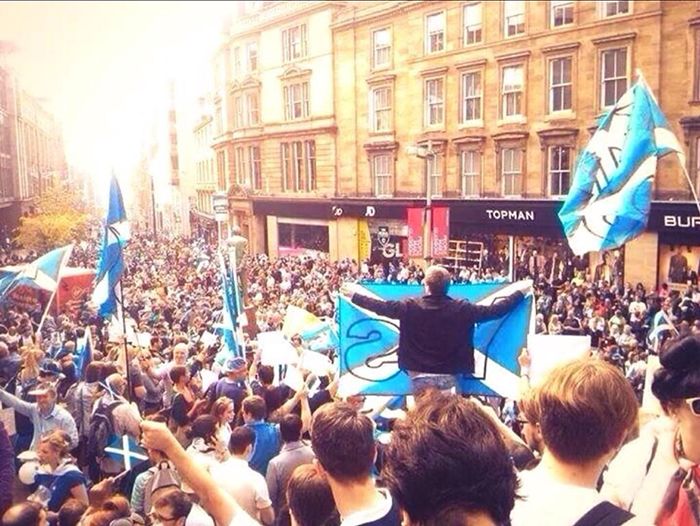
A few days before the vote, I said, based on my own subjective impressions, that "Scotland doesn't feel to me like a nation that's about to vote against its own self-determination." Replace "Scotland" with "Glasgow", and you'd be right. Glasgow voted Yes by majority, and my perception of the state of play was, not unsurprisingly, primarily based on the feeling on the ground in Glasgow. If you weren't there, it's very difficult to describe with words the feeling of being in Glasgow's city centre in the week leading up to the vote. I've never taken drugs, but I reckon likening it to a great acid trip is the best way to explain it. The whole atmosphere was one of light-headed euphoria, with spontaneous gatherings of hundreds of people singing in the streets, George Square occupied for days on end by people partying and waving flags... Even the arrival of a hundred Labour troughers to attempt to convince us to vote No took on a carnivalesque air thanks to a guy in a rickshaw who pursued them all the way from Central Station to the top of Buchanan Street playing the Imperial March from STAR WARS. It really felt like we were on the cusp of a glorious, irreverent, peaceful revolution.

So in a way my perception was accurate, but it failed to take into account the bigger picture, i.e. what was happening across Scotland as a whole. I doubt there were too many people in the Borders engaging in hundreds-strong impromptu renditions of Caledonia and Flower of Scotland, for example. The success in Glasgow was mirrored only in three other constituencies: North Lanarkshire, West Dunbartonshire and Dundee, and the fact that these are among the largest in terms of population was still not enough to swing the vote in Yes's favour.


The "scary radicals" factor

The Yes campaign was admirably inclusive, bringing together nationalists, internationalists, socialists, environmentalists, feminists, trade unionists, human rights activists, atheists, Christians, Muslims, Scottish-born Scots, Italian Scots, English Scots, Asian Scots... in other words, people from pretty much every walk of life. I've heard it mentioned that some members of the world's press who descended on Scotland in the week ahead of the vote came expecting to find something similar to Golden Dawn or some other sort of neo-fascist movement, and were bewildered to discover people of every creed, colour, gender and background united under the broad Yes banner.

Still, in one respect, there was a broad level of consensus: Yes was very much a left-wing movement, and one that made Tory-bashing part of its daily rhetoric. The chief executive of Yes Scotland, Blair Jenkins, specifically stated that one of the best reasons he could think of to vote Yes was so we would never have to endure another Tory government ever again. As inclusive as Yes might have been, it nonetheless immediately excluded a substantial minority of the electorate: the comfortably off, socially conservative upper middle class who, rather than being filled with hope when hearing talk of wealth redistribution and a root-and-branch restructuring of the economy, were instead filled with dread and focused not on what those worse off than themselves might stand to gain but rather what they themselves might stand to lose. True, the SNP's official proposals, as laid out in the White Paper, were relatively conservative, edging the country's economic and social structures towards a Nordic-style social democratic model without doing anything particularly revolutionary, but every one of the most prominent voices that made up the grassroots campaign -- from Tommy Sheridan to Cat Boyd to Robin McAlpine to Lesley Riddoch -- was calling for revolution, not evolution. The Yes campaign lacked a prominent centre-right conservative voice, which could have reached out to the sort of people that were never going to give the likes of Common Weal or the Radical Independence Campaign the time of day.

Similarly, though not unrelated as there is some definite overlap in terms of demographics, the Yes campaign failed spectacularly to engage a majority of the elderly. The polling by Michael Ashcroft on the night of the referendum makes for sobering reading, suggesting that fewer than 30% of people over the age of 60 voted Yes. In fact, if those over 60 had been excluded from voting, then according to the Ashcroft figures, Yes would have won. In some respects, this was always going to be a tough nut to crack: the over-60s are the only generation that have any widespread residual sense of Britishness, and there's not much you can do to persuade someone of the benefits of independence when the very concept is an anathema to them. However, I think any future pro-independence campaign would have to look long and hard at how to reach older voters, because it seems pretty clear that it failed spectacularly in that regard. Relating back to the echo chamber issue, the majority of people above a certain age get their information from traditional sources, i.e. newspapers and the BBC. These people weren't, by and large, popping on to Facebook or Wings Over Scotland to see the Daily Record's latest scare story being debunked. For the most part, they were only hearing one narrative, and it was the unionist one.

How do you deal with that problem in future? Well, the most morbid answer is that this demographic not going to be around indefinitely, but I think most would agree that something more proactive needs to be done than simply waiting for a certain proportion of the electorate to shuffle off the mortal coil. I don't have any definitive answers here -- I'm simply flagging it up as an issue that needs to be tackled.


The Salmond effect

Alex Salmond and Nicola Sturgeon are, by a country mile, the most popular political figures in Scotland. They have approval ratings that other UK politicians can only dream of. However, there's no denying that Salmond is a marmite figure. While a great many people respect and admire him, a great many also loathe him with a passion. Particularly in the Labour party ranks, blind hatred of the SNP in general and Salmond in particular is endemic, and I was shocked by how many people I encountered who articulated only a single reason for voting No: "Because ah can't stand that Alex Salmond." The media and the No campaign (and I really should stop referring to these as two separate entities) capitalised on this by seeking to portray the Yes campaign as Salmond's personal vanity project, focusing on him to the exclusion of virtually every other player (except perhaps Nicola Sturgeon) and essentially conducting a two and a half year long character assassination. And I suspect, incidentally, that they'd have been even more effective if they'd been able to unearth some skeletons from his past. The fact that, as far as we can tell, Salmond's personal life is squeaky clean to the point of being boring must have been a continual source of frustration for the No campaign's spin doctors. I'm actually surprised we didn't see some sort of fabricated "Salmond kicks puppies" scandal in the final days of the campaign.

It's easy to demonise a single figurehead. This was harder to do with the No campaign because it was like a Hydra. While Alistair Darling was nominally the head of the campaign, in truth plenty of other figures ratcheted up as much screen time as him, or more. Particularly in the final stages of the campaign, following his crushing defeat by Salmond in the second of two televised debates, Darling was sidelined almost completely, with the likes of Jim Murphy and Gordon Brown enjoying far higher profiles. It was far harder to run the sort of campaign against them that was run against Salmond, because frankly you'd have had to discredit at least a dozen of them. While that wouldn't be too hard in the case of Darling (i.e. the man who was in charge of the Treasury during the crash of 2008, who flipped his home four times to abuse the MPs' expenses system, and who somehow made the transition from Trotskyite radical to being warmly applauded as a guest speaker at the Conservative Party conference) the likes of Brown -- nasty, venal man though he is -- still inexplicably command a great deal of support and admiration from Labour supporters in Scotland. While to a certain extent it was the media that focused unrelentingly on Alex Salmond, I suspect the Yes campaign could have done more to push other, less divisive figures into the spotlight. This matter does need to be looked at, because in the hypothetical case of another referendum, I would imagine the press and Westminster parties will, given the opportunity, simply do to Nicola Sturgeon what they did to Salmond.


The smile factor

The No campaign's success proves one thing: fear works. If you bombard people with scare stories about their pensions, currency, EU membership status and even the bloody BBC every day for two and a half years, then a significant number will be brow-beaten into submission. Alex Salmond repeatedly claimed that the only way a negative campaign could win was if the opposition was equally negative. The result gives lie to this idea. Many of us on the Yes side spent a great deal of time laughing at the No campaign for constantly trotting out the same debunked scare stories regarding pensions, EU membership and the NHS, but the truth is that these scare stories were carefully chosen and deployed for maximum impact. As Alex Salmond put it in a speech in his constituency shortly after the referendum, frightening old people is a cheap, nasty thing to do, but it's not hard. The No campaign was the epitome of cheap and nasty, but it worked.

The Yes campaign spent a great deal of time on the defensive, rebutting the No campaign's threats and scare stories without offering up any of their own. It was only in the final weeks that the Yes side finally went on the offensive with a "scare story" (I use quotes because what they were warning about was and is very real, in stark contrast to much of the utter bilge Better Together spewed out) of its own: the threat of a No vote to the Scottish NHS. I think the official Yes campaign tried too hard to replicate the template the SNP harnessed in their 2007 and 2011 election campaigns to such great effect, setting out their stall on the basis of can-do positivism in the face of their opponents' can't-do negativity, but this wasn't an election and they shouldn't have assumed the same rules would apply.

I think the Yes movement can be proud of its campaign for a great many reasons, not least the fact that for the most part it refused to stoop to the level of its opponents. However, the unfortunate truth is that, if your opponent goes around telling lies about you and calling you every name under the sun, it does you little good to behave like a perfect gentleman, smile and say "I love you too." With the odds stacked so highly against it, the Yes campaign needed to be willing to fight dirty. I lost count of the number of times it seemed that, in interviews and debates, Yes representatives appeared to miss open goals out of a desire to appear "nice" and "reasonable". I'm sorry, but when the people you're up against include proven liars, war criminals and expenses cheats, who describe you as "a virus", Nazis and "not genetically programmed to make political decisions", who are willing to tell the elderly and the terminally ill that their pensions will be cut off and that they will be ineligible for organ transplants in the event of a Yes vote, then "nice" and "reasonable" go out the window.


That's about all I've got to say on the subject, for the time being. Obviously, this is still a raw wound for me, and there's little to be achieved by playing out an endless series of what-ifs. Still, I very much hope we're going to get a second bite of the cherry sooner rather than later, and if/when we do, it won't do us any good if we just make the same mistakes all over again. So let's be proud of what we did right, but realistic about what we did wrong, and start figuring out NOW rather than at the last minute what we're going to do differently next time.

A message from the 45%


Today in Freedom Square (formerly known as George Square), the message to Westminster was ringing out loud and clear: "We're not going anywhere."

(Photo by Paddy Gordon)

Asterix enters the third dimension


I'm a big fan of the late René Goscinny and Albert Uderzo's Asterix books, though the various film adaptations have been more of a mixed bag. The full length theatrical trailer has now emerged for the upcoming CGI-animated ASTÉRIX: LE DOMAINE DES DIEUX (ASTERIX: THE LAND OF THE GODS in English), and, while I was somewhat sceptical about the idea of a computer-generated Asterix film, I must admit I'm actually pretty impressed by what I'm seeing. I love the snappy timing, and the animation has a pleasingly pliable quality to it, even if the characters do have that all too familiar look of being made of rubber. Of course, Uderzo's drawings always had an amazing sense of dimensionality to begin with, making the transition from 2D to 3D less awkward than something like, say, Tintin. It also happens to be based on one of my favourite books in the series, THE MANSIONS OF THE GODS.

Directed by Louis Clichy and Alexandre Astier and produced by M6, the same studio that co-produced the previous animated Asterix film, ASTERIX AND THE VIKINGS, this one appears to be far heavier on rapid-fire dialogue and wordplay than any of the earlier films in the series, which may well end up bringing it closer to the spirit of the original books, whose speech bubbles were packed full of puns and cultural allusions. I'm certainly intrigued to see how this turns out, and hope I don't have to wait too long beyond the French theatrical release date of 26th November.

Thursday, 9 October 2014

Snow queen


Because it's all been a bit heavy here recently, what with all this talk of politics, referenda and the crushing of dreams, here's a picture that combines two of the best things in life: redheads (in this case the glorious Emma Stone) and snow.

Friday, 3 October 2014

What now?


I've deliberately avoided writing about the Scottish independence issue for the last week or so. I spent most of the weekend following the referendum feeling numb, angry and completely hopeless, with the double whammy of losing the vote followed shortly afterwards by Alex Salmond's snap decision not to stand for re-election as leader of the SNP in November leaving me devastated. (And how galling it was to watch the man who'd safeguarded our NHS, delivered free prescriptions, university tuition and care for the elderly announcing his resignation, while war criminals, expenses frauds and proven liars smirked and patted themselves on the back.) I wanted to take some time to let my emotions settle and to mull over the main question that must be on every single pro-independence campaigner's mind -- namely "What now?"

It seems reasonable to suggest that the independence movement will not go quietly into the night. In fact, I've been surprised by just how quickly so many people came to terms with the crushing despair of having lost the referendum and immediately began to regroup, speculating as to what the next step should be for the movement. It will undoubtedly change in terms of its immediate goals and tactics, but the long term aim -- independence for Scotland -- remains firmly on the agenda. It certainly remains my aim, though I'm pragmatic enough to assume that, at present, it's off the menu for at least a few years. The people have spoken, and all that. Many of them may have been cajoled, intimidated and deceived into voting No, but vote No they did, and as democrats we have to accept (I almost typed "respect", but decided against it) the result.

That said, I was intrigued that Nicola Sturgeon, when launching her bid for leadership of the SNP (and there can be little doubt that she'll succeed, given that so far no-one has come forward to challenge her, with every other potential candidate giving her their backing), refused to rule out calling another referendum in the future. It would be absurdly unwise for the SNP to go into the next election with the promise of another referendum in their manifesto -- I expect they would be slaughtered at the ballot box by an electorate that's had its fill of rederenda after two and a half years of argument -- but keeping it on standby as a potential weapon to whip out in the event of a dramatic change of circumstances is a wise move.

What would constitute such a change of circumstances? Well, for one thing, the three Westminster parties reneging on the vows they dreamt up on the back of a fag packet in the final weeks of the campaign. For another, the looming EU in/out referendum the Conservatives are promising in 2017. If a scenario were to emerge whereby England voted by majority to leave the EU and Scotland voted by majority to remain (as the polls tend to suggest), then in my view the Scottish Government would be entirely justified in calling a snap independence referendum on the grounds that the tectonic plates had shifted. And they'd probably win it comfortably.

In the meantime, the SNP's immediate goal appears to be holding Westminster to account over the grandiose promises it made in the run-up to the vote. The words "DevoMax" and "federalism" were trotted out several times -- words with specific meanings, but which both the politicians and the media cynically used to make what they were offering sound more impressive than it actually was. "DevoMax", for the avoidance of any doubt, means maximum devolution, i.e. full control of all matters except defence and foreign affairs. Nothing the three Westminster parties have offered (and all are proposing different packages, with Labour's by far the most feeble) comes even remotely close to fulfilling those criteria, but DevoMax we were promised, so DevoMax we will demand. There can be little doubt that Sturgeon will be all too willing to remind them of the language they used when the negotiations begin.

Apparently, in the most recent issue of the Sun on Sunday, David Cameron stated a desire to give Scotland the power to raise and spend all its own money. I have my doubts that he really means this, as it would mean saying goodbye to all those lovely oil revenues. However, let's take these comments at face value for a moment. Realistically speaking, Cameron has little to lose by offering Scotland as much autonomy as possible. There is, after all, only a single Tory MP north of the border, so in a sense Scotland is already a write-off from the Conservative Party's point of view. Any significant transfer of powers would undoubtedly mean reducing Scotland's presence at a UK parliamentary level to compensate, but something tells me Cameron wouldn't lose much sleep over axing a single MP. On the other hand Labour, with its 40 Scottish MPs (at least until the 2015 general election), has far more to lose, which probably explains why Labour's devolution proposals are so toothless. Indeed, Cameron's "English votes for English laws" drive, announced the morning after the referendum in his victory speech, looks more and more like a cunning trap laid for Ed Miliband and his party.

(Incidentally, I have absolutely no problem with the idea of "English votes for English laws", and indeed I commend the SNP's Westminster MPs for adopting the principled stance of not voting on matters that are devolved to the Scottish parliament. That said, there are certain caveats, the most significant one being that the budget Scotland receives is set by Westminster, and a situation could potentially arise whereby Scottish MPs are unable to vote on motions that impact on the Scottish budget.)

Allow me some pie-in-the-sky thinking for a moment. Imagine a scenario by which the UK moved to a truly federal settlement whereby each of the four nations was completely financially autonomous. If such a situation came to pass, then in many respects the question of independence becomes a moot point. I'm not a hard line Scottish nationalist, and wouldn't have too much of a problem with the idea of a union called the United Kingdom continuing in some form, provided Scotland was allowed to govern its own affairs within that union. The only downside (and it is a major one, I admit) is that it does nothing to extricate us from the UK's disastrous foreign policy or resolve the presence of nuclear warheads just miles from our most populous city. That's why, at the end of the day, while I would take DevoMax or federalism as the next best thing, it's still a lesser alternative to true independence, which I believe must remain the ultimate goal. For the time being, though, I believe the immediate task must be to, as Alex Salmond put it, "hold Westminster's feet to the fire" and ensure that they deliver on their promises.

Crucial to this is going to be getting as many pro-independence MPs sent to Westminster in the 2015 general election as possible. Scotland currently has 59 MPs, of whom a mere six are SNP. The rest consist of 40 Labour, 11 Liberal Democrats, and a solitary Tory in the rather weird Dumfriesshire, Clydesdale and Tweeddale constituency. The Lib Dems are, it's safe to assume, pretty much toast, barring in their strongholds in the Highlands and Islands, so the main priority must surely be to unseat as many Labour troughers as possible. That's a hard ask -- many of them have massive majorities, and in many constituencies the SNP came third or fourth in the most recent general election. Nothing would give me greater pleasure than to see Labour annihilated in Scotland -- words cannot express how much I despise them and the way they cynically wrap themselves in the flag of social justice while doing nothing to alleviate the poverty the blights their strongholds -- but I'm pragmatic enough to accept that this is unlikely. The "ah vote Labour cuz ma da voted Labour" force is still strong.

That said, the ground appears to be shifting. The Labour citadels of Glasgow and North Lanarkshire both voted Yes by majority (in fact, every single constituency in Glasgow recorded an overall Yes vote), so it may be that the idea of the safe Labour seat is coming to an end. YouGov president Peter Kellner published an interesting article the other day speculating as to the likely makeup of the 2015 parliament, going to far as to suggest that the SNP could potentially hold the balance of power in the same way that the Liberal Democrats did in 2010. If that's the case, then the main precondition for any sort of coalition or confidence and supply arrangement must be a guarantee of full DevoMax.

When 2016 and the Scottish elections swing around, the picture is slightly different. The SNP already hold an absolute majority in the Scottish parliament under a system of proportional representation -- an anomaly that was never supposed to happen. It's feasible that they could return to being a minority government, which they previously managed successfully between 2007 and 2011, but I wouldn't like to suggest that a second majority is completely out of the question. It's certainly highly unlikely, barring some sort of scandal that rocks the incumbent government, that Labour will be back in power in 2016, and as for the Tories and Lib Dems -- forget it. The Tories might just cling on, as there's a core bloc that continues to vote for them come hell or high water, but the Lib Dems have already been reduced to a rump of five MSPs, and are for all intents and purposes irrelevant. The Greens currently only have two MSPs, but they stand a strong chance of increasing their presence, and the fact that the vast majority of their new members will be disillusioned Yes voters (membership has trebled since the referendum) means that the party is unlikely to abandon the pro-independence stance that it only reached after considerable internal debate.

So for the time being, the primary goal seems to be to pack both parliaments with as many pro-Yes MPs and MSPs as possible, and to use that position to agitate for a far more impressive package of new powers than what any of the three Westminster parties are currently proposing. I believe we should dismiss any thought of planning to hold another referendum in the immediate future, but to retain it as an option should (a) Westminster renege on its vows and/or (b) we find ourselves being dragged out of the EU against our will. The matter of independence has not, despite the wishes of the No campaign, been settled, and it's entirely possible that we could find ourselves at the ballot box once again within the next decade.

UP NEXT: My thoughts on why the Yes campaign failed.

Sunday, 28 September 2014

A bumper box of spooktacular fun


With Halloween just over a month away, I decided to treat myself and picked up Anchor Bay's recently released 15-disc deluxe HALLOWEEN: THE COMPLETE COLLECTION Blu-ray box set, containing the eight original HALLOWEEN films and the two Rob Zombie remakes. Having only ever seen the first film, HALLOWEEN H20 and the first Zombie film, this is a bit of a gamble for me, and I'm aware that, as is invariably the case with long-running series, most people are of the opinion that the law of diminishing returns kicks in pretty quickly.

That said, the HALLOWEEN series is more or less required viewing for any horror fan, and it's always been a source of mild embarrassment to me that it's taken me so long to correct this oversight. Besides, this set includes the holy grail that is the producer's cut of HALLOWEEN: THE CURSE OF MICHAEL MYERS, in addition to correcting the botch job that was done on mono audio track of the standalone release of the first film. (I sat down to watch it back in July and it would be no exaggeration at all to say that the balance between dialogue, FX and music was so bad as to render it unwatchable. I ended up watching it with the 7.1 remix selected instead.)

I'm not sure whether I'll have the time or inclination to do a write-up for each film in the series, but I'd quite like to write up my overall thoughts in the series once I've had the chance to see it from beginning to end.

Wish me luck!

Thursday, 25 September 2014

Try not to laugh when you read this

This was posted by someone in one of the Facebook groups of which I'm a member. Published by the Daily Express in 1991, it predicts what life will be like in 2010. It would be funny if the reality wasn't so tragically different.

Monday, 22 September 2014

You are the company you keep

The independence referendum was a bit of an eye-opener for me in that it revealed not only the depths to which the establishment was prepared to sink in order to hang on to vested interests, but also the willingness of supposedly sworn enemies to reveal that, in reality, you couldn't put a cigarette paper between them. Not only were Labour happy to stand shoulder to shoulder with the Tories -- they were also more than happy to cooperate with even less salubrious individuals.

For instance, here's Labour MP for Aberdeen South Anne Begg posing in a cosy clinch with the delightful Dave MacDonald, leader of the Scottish National Front:


And here's ginger rodent Danny Alexander, Liberal Democrat MP for Inverness, Nairn, Badenoch & Strathspey, campaigning side by side with Scotland's sole UKIP MEP, the charming David Coburn:


Lends a whole new meaning to the words "Better Together", doesn't it?

(Images source: Wings Over Scotland)

Sunday, 21 September 2014

And on a happier note...

On Friday night, Glasgow's city centre was blighted by the ugliest scenes of violence and hatred I've seen in the city in my lifetime. The following day, in the same location where less than 24 hours ago knuckle-dragging Neanderthals draped in Union Jacks had performed Nazi salutes and assaulted innocent bystanders, this appeared:


These are donations for the city's many food banks. My faith in humanity is some way towards being restored.

Saturday, 20 September 2014

A tale of two cities

Glasgow a week ago...


And last night...


These two videos sum up the difference in the mood of this city before and after the independence referendum. Thousands of peaceful Yes supporters occupied George Square for days in the run up to the vote, without a single incident. Late on the afternoon of the 19th, following the No vote, knuckle-dragging louts associated with the Orange Order and the BNP descended on George Square. They attacked the small number of remaining Yes supporters, screamed abuse at them, burned flags and performed Nazi salutes under the shadow of the memorial to the World War 2 dead. Riot police arrived and managed to contain them, but a number dispersed throughout the city centre, leading to scenes like the one in the video above on Buchanan Street.


Out today on Dumbarton Road, the main road running through Partick, the mood was palpably grim. Whether people were Yes or No voters, I could see little evidence of anyone being happy with the outcome. With the first of the three Westminster leaders' promises (a timetable for further devolution published before parliament the day after a No vote) reneged on already, I suspect that a great many who voted to remain in the union are already waking up to the fact that they voted for a pack of lies.

Friday, 19 September 2014

Fuck.


Right now, I reckon I feel just about as low as it's possible to feel, short of suffering a bereavement. Last night, we had a once in a lifetime chance to make a fresh start, and we threw it away.

Well, 45% of us took that chance. The other 55% decided, for a variety of reasons that are their own, to endorse the status quo. The majority, I'm sure, did so because they genuinely believed it to be the best thing for the country, and I really, REALLY hope they're right. But I can't shake the feeling that in doing so, they implicitly voted for a future that consists of more austerity, food banks, privatisation of the Welfare State, the House of Lords, an undemocratic electoral system, and billions spent on immoral nuclear weapons in the Clyde while one in five children grows up living below the poverty time. The polls suggest that the young and the poor voted Yes, while the rich and the elderly voted No. This was always essentially a class and a generational struggle, and the working class and the young, as is so often the case, got kicked in the teeth last night.

About a year ago, I told myself that in future, if anyone who voted No complained about anything that came our way via the Westminster government, I would quietly remind them that they endorsed it with their vote. I'm not going to do that. It's petty and stupid and helps no-one. People voted No for a variety of reasons, but there's little doubt in my mind that many of the crucial 5% that could have taken us over the finish line did so out of fear. For two and a half years, but especially in the last fortnight, we have been bombarded with a barrage of scare stories dreamed up by the self-titled Project Fear campaign and dutifully reported, without any interrogation, by the supine media. No threat was too great. The elderly were told they would lose their pensions, immigrants were told they would be deported, the terminally ill were told they would be denied life-saving operations... Unable to construct a positive case for the union, they instead settled on bullying the most vulnerable into voting No out of fear.

45% of the electorate won't forget that. In circling the wagons to protect the interests of the establishment, I believe the Labour Party, the BBC and indeed mainstream media as a whole have completely shredded their trust with a significant portion of the population. Many will never vote for them or buy their products again, making this a pyrrhic victory for them. Already, the last minute promises of new powers are unravelling, as backbench Tories declare their intent to vote down any transfer of powers to Holyrood, and already the language has shifted away from "DevoMax" to "extensions of existing powers". Such is life. Tories will be Tories. But I reserve my greatest contempt for the Labour Party, who I suspect will bear the brunt of Yes voters' anger for years to come. The sight of them cheering and dancing with their supposed adversaries the Tories made me sick to my stomach, and I suspect that is an image that will long remain in the minds of their former supporters. The fact that their traditional heartlands -- Glasgow, Dundee, North Lanarkshire, West Dunbartonshire -- voted Yes suggests that they are in for a well-deserved annihilation.

In the end, we fought the good fight, but it wasn't enough. We took on the combined might of the media, the banks, big business, Westminster and a seemingly endless stream of sycophantic "celebrities". We put up a good fight, but we lost. What comes next, I've no idea. I suspect we're going to have a fight on our hands just to get the baubles we were belatedly promised. But I also suspect that, when the dust settles and people realise they've been duped, demand for a second referendum will grow louder and louder. Alex Salmond, who has more magnanimity than I'm capable of possessing at the moment, says that the matter is settled for a generation. With respect, he may find that that is not his decision to make.

As the saying goes, fool me once, shame on you. Fool me twice, shame on me. In 1979, we were narrowly cheated out of getting our own parliament. In 1997, we voted for it by an overwhelming majority. History has a habit of repeating itself. 1.6 million people last night voted Yes. That is not, by any stretch of the imagination, a decisive vote of confidence in favour of the Union. And the young, angry and newly enfranchised electorate that voted for independence last night will still be around long after the over-60s who voted for the status quo are no longer with us.

Sunday, 14 September 2014

The final stretch

My nerves are in tatters. I'm having difficulty sleeping, and even more difficulty concentrating on anything other than constantly refreshing my Facebook and Twitter feeds. I'm lurching between extreme feelings of optimism and pessimism several times a day.

Why? Because we're entering into the final stretch of the campaign for Scottish independence. Four days and it'll all be over. By any stretch of the imagination, it's been a long campaign, and yet I still can't believe we're nearly there.

And I still have no idea how it's going to go. The polls are all converging in the middle, with one or two outliers on either side, but all agree that there's more or less a 50/50 split between Yes and no. A poll released yesterday by Survation put Yes on 47% and No on 53%. Mere hours later, however, the situation was reversed by an ICM poll putting Yes on 54% and No on 46%. The feeling on the ground for me is that Yes is ahead, but to a large extent I suspect that's down to the fact that most of my friends are in their late twenties to early thirties -- by some margin the most Yes-friendly demographic. Every day I'm seeing amazing, awe-inspiring sights, either in person or online -- Buchanan Street brought to a standstill yesterday by Yes supporters, or an estimated 4,000 (as per Sky News) marching past my workplace during my lunch break today, on their way to Pacific Quay to protest against the BBC's shameful anti-independence propaganda. The past week has seen the most shocking concerted blitzkreig against the Yes campaign, orchestrated by Downing Street with the complicity of the banks, big business and the mainstream media, and yet the smiling, happy faces wearing their Yes badges and waving their saltires seem undaunted. And the polls have continued to narrow. Scotland doesn't feel to me like a nation that's about to vote against its own self-determination.

And yet there are still so many people who remain steadfastly opposed to a Yes vote, even if many of them do genuinely like the idea of independence. Where I and others like me see opportunity, they see only risk. Where we see an end to nuclear weapons, illegal wars, food banks and privatisation of the NHS, they fret about currency, capital flight and their pensions (which ironically are at far greater risk if we vote No). I understand their fear, and I don't hold it against them. By and large, these people have, in my estimation, been brow-beaten by a two-and-a-half-year barrage of negativity and scaremongering into believing that it's all too risky and that Scotland, uniquely out of all the countries in the world, is too feckless to look after its own affairs. I find that unbelievably sad and, though I know I'm going to sound like one of these "true believers", I'm going to say it: I wish I had some way of showing these people what I've seen. And I hope, if we vote Yes on Thursday, that they'll eventually see it too.

An unprecedented 97% of the adult population is registered to vote. Some are predicting a turnout approaching 90%. Whatever happens on Thursday, we have brought democracy out of retirement. The general population is engaged in the democratic process like never before. People of all backgrounds, ages, genders and ethnicities are earnestly talking politics in a way that would have been unthinkable a couple of years ago and is, I suspect, still unthinkable throughout the rest of the UK. And the other side hate it. You can see it in the contorted faces of Alastair Darling, Gordon Brown, Johann Lamont, George Galloway and all the various LibLabCon clingers-on. They absolutely LOATHE this process. On Thursday 18th September, the people hold the power, and it scares the shit out of them.

This will most likely be my last significant post on the subject before Thursday, so I'll say nothing more for the time being other than "See you on the other side", and, come Friday, if I disappear off the face of the earth for a couple of days, you'll know it's because I'm either celebrating or drowning my sorrows in Pepsi Max.

To quote Irvine Welsh, good luck, Scotland, "you gorgeous handsome sexy democratic bastard, you."

Monday, 8 September 2014

The flood continues


http://scotgoespop.blogspot.co.uk/2014/09/yes-draw-level-in-electrifying-poll.html

Something incredible seems to be happening. Over the last couple of weeks, two of the most No-friendly pollsters, YouGov and TNS-BMRB, have recorded support for a Yes vote on the 18th increasingly exponentially. The YouGov poll that hit the interweb on Saturday night put it two points ahead of No, while the results of the TNS poll that emerged tonight add weight to the trend observed by YouGov, showing the two sides level-pegging.

I really didn't think anything like this would happen. I was more or less resigned to the notion of Yes remaining the underdog as we went to the polls and banking on a large number of non-voters beyond the reach of such surveys turning out to swing things in our favour. And if you'd told me a week ago that YouGov and TNS would be the first two pollsters to show Yes level pegging, let alone in the lead, I'd have laughed at you and called you delusional.

I mentioned recently, either on Facebook or on this very blog, that because this referendum has no precedent, the various pollsters are more or less casting around in the dark in their attempts to get their weighting criteria right, hence why the numbers from the different firms have been all over the shop. I still stand by that assertion, which is why I'm not going to assume these two polls are accurate simply because they show my side in a favourable position. What the polls do do, however, is allow us to observe broad trends over time, and YouGov and TNS both appear to be telling us that there has been a massive swing to Yes in an incredibly short space of time. If you believe YouGov, No has gone from enjoying a 22-point lead to a 2-point deficit in the space of a month. That is literally extraordinary, but shows an echo of the 2011 Scottish Parliament election, which saw the SNP turn a 20-point deficit into a 15-point lead in the final weeks.

I'm not going to break out the champagne and declare premature victory. These polls are the living proof that a week is a long time in the world of politics, and for all we know both firms could be drastically overestimating the support for Yes. And there is no doubt in my mind that the UK government, aided by a supine media, will throw everything they've got at us in an attempt to defeat what, to them, is the single greatest constitutional crisis in the union's history. But this is certainly the most confident I've ever felt that we're on our way to victory.

On a side note, I'm absolutely loving the fact that the Westminster Village and adoring media hangers-on have finally woken up to the fact that yes, there is a referendum taking place in Scotland, and yes, it could mean the end of the United Kingdom. Things have certainly got a whole lot more entertaining since these gormless twits started pontificating about it in the newspapers and on TV. The other night, for instance, I came across a couple of ladies on the BBC News channel doing a "review" of the papers and struggling to comprehend the headlines they were seeing about Yes pulling ahead in the polls. One made tired jokes about rebuilding Hadrian's Wall (which is some 68 miles south of the border between Scotland and England) and lamented the fact that she had Scottish blood in her family tree somewhere and that it was most unfair that she didn't get to vote, while the other wailed "I just don't think they've thought this through!" Yes, because you, who've only belatedly realised that this debate is actually taking place, naturally understand it far better than those of us who've been engaging with it for the last three years.

Dolts.

And, to end on a somewhat tongue-in-cheek note...


I'm not going to lie -- it was my first thought this morning when I read the "news" that unemployed mum-on-benefits Kate Middleton is up the duff again. While I wouldn't go so far as to suggest that she was impregnated by royal decree in a bid to save the union (because nothing unites the four nations like a royal brat, or some such nonsense), the cynic in me does wonder at the timing of the announcement.

There's no doubt in my mind, incidentally, that if we win our independence on the 18th, the next major constitutional cause I'll be throwing my backing behind will be the abolition of the monarchy. An independent, social democratic Scottish republic has kind of a nice ring to it.

Saturday, 6 September 2014

Here comes the flood


But don't worry, defenders of the union, the great statesman and paragon of internationalist socialism that is Ed Miliband has devised a cunning ruse to hold back the turning of the tide: