Showing posts with label johann lamont. Show all posts
Saturday, 15 November 2014
Changing of the guard
Yesterday, the first day of the SNP's annual party conference in Perth, saw the reins of party leader formally handed over from Alex Salmond to Nicola Sturgeon, in what was easily the most seamless transition of power I've ever witnessed. I'm certainly struggling to think of any other political leader in recent history elected on 100% of her party's vote... though it certainly helped that no-one was foolhardy enough to stand against her.
Sturgeon and Salmond share similar backgrounds. Born in a council house (in Prestwick rather than Linlothgow), she attended a state school and benefited from a free university education (she studied Law at Glasgow University, while Salmond studied Economics at St. Andrews') and joined the SNP at the age of 16 (she was already a member of the CND). She has always been an incredibly shrewd and capable political operator, and opponents underestimate her at their own peril. For instance, in a now-notorious STV debate, she famously reduced Scottish secretary and supposed "bruiser" Alistair Carmichael (seriously, Google his name and "bruiser" and see how many hits turn up) to a blithering wreck who asked moderator Rona Dougall to intervene on his behalf. (Her weary response -- "Answer the question, Alistair" -- was the icing on the cake.) The unionist parties may like to smugly characterise her election as a "coronation" and point out that she has spent the last seven years being groomed to step into Salmond's shoes, but there's little sense of political nepotism in her appointment -- she really is, by a country mile, the best person for the job.
Sturgeon's ascendancy also leads us to the unprecedented situation of all three major parties being led by women. (I'm including Labour even though, strictly speaking, Westminster MP Anas Sarwar is currently standing in as branch officer following Johann Lamont's applecart-spilling resignation. In any event, Labour's interim Holyrood spokesperson is also a female of the species, Jackie Baillie. And as for the dear old Lib Dems... well, does anyone outside of their own rapidly contracting party even remember who their leader in Scotland is?) I'm not so naive as to suggest that a party being led by a woman is automatically preferable to its being led by a man (just look at Margaret Thatcher, or her spiritual successors, the current leader of the Scottish Tories and the outgoing leader of Scottish Labour), but anything that breaks the political stranglehold of the old boys' club has got to be a step in the right direction. More pertinent, I feel, is that Sturgeon, like Salmond before her, wasn't born into a life of privilege and has got to where she is today through a lot of hard work rather than because she went to the right university and rubbed shoulders with the right people.
Yesterday also saw the party's depute leader elected, with Stewart Hosie coming first with 59% of the vote, from a pool of three candidates. The only Westminster MP to stand for the position, Hosie was my first choice (the election used the single transferrable vote system, allowing you to rank candidates in order of preference), primarily because he's a very smooth, capable operator who comes across extremely well whenever he's interviewed. He strikes me as a hard man to rattle, which is good because he'll no doubt be spending a lot more time in the glare of the media spotlight from now on. There is another advantage, though: it gives the SNP a more prominent profile in Westminster -- something that will no doubt be required if the party is to be successful in its stated goal of winning a majority of Scottish seats in the 2015 election. It also allows Sturgeon the opportunity to choose her own Deputy First Minister for the Holyrood parliament -- effectively two for the price of one.
I'm incredibly sad to see Alex Salmond go, and a part of me still wishes he could have been talked out of falling on his sword. He's been such a staple of Scottish political life for so long that the thought of someone else standing at the dispatch box is genuinely difficult to get my head around. There's also the principle of the matter: Salmond has behaved with integrity throughout his political life, and it seems mighty unfair that someone of his character is stepping down while the assorted pirates and cutthroats of the LibLabCon "Better Together" alliance are (for now, anyway) congratulating themselves and each other on a smear campaign well done and/or being measured for their ermine robes. (Little known fact: he donates a third of his salary to charity every year. The fact that he has never publicised this says a lot about the sort of person he is.) That said, it's becoming increasingly clear that, despite standing down as party leader and First Minister, he has no intention of disappearing into the shadows. And it strikes me that a renegade Salmond, unshackled from the responsibilities of First Minister, could well prove to be far more of a thorn in the side of the British state than he ever was in office.
Labels:
alex salmond,
anas sarwar,
cnd,
conservatives,
holyrood,
johann lamont,
labour,
liberal democrats,
margaret thatcher,
nicola sturgeon,
politics,
scottish independence,
snp,
stewart hosie,
stv,
westminster
Saturday, 25 October 2014
Ding dong...
I woke up this morning to the news that Johann Lamont, "leader" of "Scottish" Labour, had resigned with immediate effect, giving an exclusive interview in the party's house journal, the Daily Record. In doing so, she has become the fourth SLab leader in a row to be seen off by Alex Salmond since he became First Minister in 2007. This just shy of a month after giving an interview to the same newspaper in which, following mounting speculation that the knives were being sharpened for her, she insisted that she was going nowhere and proclaimed her ambition to be the next First Minister. (OK, stop laughing...)
Artist's impression of Lamont's political fortunes
in the Yes-supporting Sunday Herald last week.
With her excruciating performances on Thursday mornings at First Minister's Questions and a knack for soundbite gaffes that would make George W. Bush blush, Lamont never appeared comfortable in the role of party leader, and has looked like a (political) dead woman walking for at least the last year. She also came across, either as a result of her actual personality or the scripts prepared for her by her spin doctors, as a bitter, spiteful individual -- a perception given credence by the hand grenade she lobbed at the party's Westminster leadership on her way out the door. She claims to be sick of being overruled by London, whom she accuses of running the Scottish division as little more than a regional branch office, and of failing to understand that Scotland's political centre is now Holyrood, not Westminster. (We could have told you that, Johann.)
That's right, the woman who campaigned so strenuously for Scotland to remain governed by Westminster has resigned because she doesn't like being governed by Westminster. I presume she doesn't "do" irony.
In my view, Lamont's departure is both a blessing and a curse to the Yes side. A blessing, because she leaves SLab in such a state of utter turmoil that it's difficult to see how it can recover. There is no heir apparent to her "crown" -- calling the talent on the Labour benches at Holyrood third rate would be overly charitable, and her accusations of London interference means that any "big hitter" parachuted in from the Westminster benches is going to have about as much credibility as... well, Johann Lamont. On the other hand, Lamont's ineptitude has long been viewed as a gift to the SNP. Truly, she was so poor that whoever replaces her can't help but look better by comparison. Then again, much the same was said of her predecessor Iain Gray...
One thing's for sure, I doubt the BBC's James Cook had any idea he was writing the epitaph for Lamont's career when he made this observation to her on a panel show back in August:
Labels:
alex salmond,
daily record,
holyrood,
iain gray,
james cook,
johann lamont,
labour,
politics,
snp,
westminster
Sunday, 14 September 2014
The final stretch
My nerves are in tatters. I'm having difficulty sleeping, and even more difficulty concentrating on anything other than constantly refreshing my Facebook and Twitter feeds. I'm lurching between extreme feelings of optimism and pessimism several times a day.
Why? Because we're entering into the final stretch of the campaign for Scottish independence. Four days and it'll all be over. By any stretch of the imagination, it's been a long campaign, and yet I still can't believe we're nearly there.
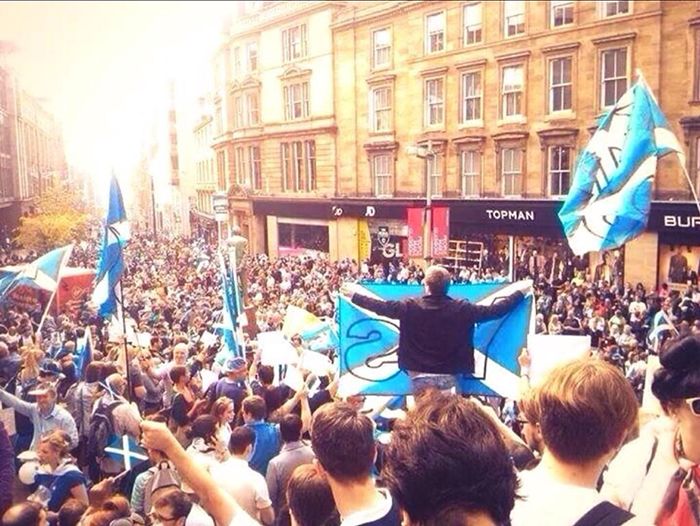
And I still have no idea how it's going to go. The polls are all converging in the middle, with one or two outliers on either side, but all agree that there's more or less a 50/50 split between Yes and no. A poll released yesterday by Survation put Yes on 47% and No on 53%. Mere hours later, however, the situation was reversed by an ICM poll putting Yes on 54% and No on 46%. The feeling on the ground for me is that Yes is ahead, but to a large extent I suspect that's down to the fact that most of my friends are in their late twenties to early thirties -- by some margin the most Yes-friendly demographic. Every day I'm seeing amazing, awe-inspiring sights, either in person or online -- Buchanan Street brought to a standstill yesterday by Yes supporters, or an estimated 4,000 (as per Sky News) marching past my workplace during my lunch break today, on their way to Pacific Quay to protest against the BBC's shameful anti-independence propaganda. The past week has seen the most shocking concerted blitzkreig against the Yes campaign, orchestrated by Downing Street with the complicity of the banks, big business and the mainstream media, and yet the smiling, happy faces wearing their Yes badges and waving their saltires seem undaunted. And the polls have continued to narrow. Scotland doesn't feel to me like a nation that's about to vote against its own self-determination.
And yet there are still so many people who remain steadfastly opposed to a Yes vote, even if many of them do genuinely like the idea of independence. Where I and others like me see opportunity, they see only risk. Where we see an end to nuclear weapons, illegal wars, food banks and privatisation of the NHS, they fret about currency, capital flight and their pensions (which ironically are at far greater risk if we vote No). I understand their fear, and I don't hold it against them. By and large, these people have, in my estimation, been brow-beaten by a two-and-a-half-year barrage of negativity and scaremongering into believing that it's all too risky and that Scotland, uniquely out of all the countries in the world, is too feckless to look after its own affairs. I find that unbelievably sad and, though I know I'm going to sound like one of these "true believers", I'm going to say it: I wish I had some way of showing these people what I've seen. And I hope, if we vote Yes on Thursday, that they'll eventually see it too.
An unprecedented 97% of the adult population is registered to vote. Some are predicting a turnout approaching 90%. Whatever happens on Thursday, we have brought democracy out of retirement. The general population is engaged in the democratic process like never before. People of all backgrounds, ages, genders and ethnicities are earnestly talking politics in a way that would have been unthinkable a couple of years ago and is, I suspect, still unthinkable throughout the rest of the UK. And the other side hate it. You can see it in the contorted faces of Alastair Darling, Gordon Brown, Johann Lamont, George Galloway and all the various LibLabCon clingers-on. They absolutely LOATHE this process. On Thursday 18th September, the people hold the power, and it scares the shit out of them.
This will most likely be my last significant post on the subject before Thursday, so I'll say nothing more for the time being other than "See you on the other side", and, come Friday, if I disappear off the face of the earth for a couple of days, you'll know it's because I'm either celebrating or drowning my sorrows in Pepsi Max.
To quote Irvine Welsh, good luck, Scotland, "you gorgeous handsome sexy democratic bastard, you."
Why? Because we're entering into the final stretch of the campaign for Scottish independence. Four days and it'll all be over. By any stretch of the imagination, it's been a long campaign, and yet I still can't believe we're nearly there.
And I still have no idea how it's going to go. The polls are all converging in the middle, with one or two outliers on either side, but all agree that there's more or less a 50/50 split between Yes and no. A poll released yesterday by Survation put Yes on 47% and No on 53%. Mere hours later, however, the situation was reversed by an ICM poll putting Yes on 54% and No on 46%. The feeling on the ground for me is that Yes is ahead, but to a large extent I suspect that's down to the fact that most of my friends are in their late twenties to early thirties -- by some margin the most Yes-friendly demographic. Every day I'm seeing amazing, awe-inspiring sights, either in person or online -- Buchanan Street brought to a standstill yesterday by Yes supporters, or an estimated 4,000 (as per Sky News) marching past my workplace during my lunch break today, on their way to Pacific Quay to protest against the BBC's shameful anti-independence propaganda. The past week has seen the most shocking concerted blitzkreig against the Yes campaign, orchestrated by Downing Street with the complicity of the banks, big business and the mainstream media, and yet the smiling, happy faces wearing their Yes badges and waving their saltires seem undaunted. And the polls have continued to narrow. Scotland doesn't feel to me like a nation that's about to vote against its own self-determination.
And yet there are still so many people who remain steadfastly opposed to a Yes vote, even if many of them do genuinely like the idea of independence. Where I and others like me see opportunity, they see only risk. Where we see an end to nuclear weapons, illegal wars, food banks and privatisation of the NHS, they fret about currency, capital flight and their pensions (which ironically are at far greater risk if we vote No). I understand their fear, and I don't hold it against them. By and large, these people have, in my estimation, been brow-beaten by a two-and-a-half-year barrage of negativity and scaremongering into believing that it's all too risky and that Scotland, uniquely out of all the countries in the world, is too feckless to look after its own affairs. I find that unbelievably sad and, though I know I'm going to sound like one of these "true believers", I'm going to say it: I wish I had some way of showing these people what I've seen. And I hope, if we vote Yes on Thursday, that they'll eventually see it too.
An unprecedented 97% of the adult population is registered to vote. Some are predicting a turnout approaching 90%. Whatever happens on Thursday, we have brought democracy out of retirement. The general population is engaged in the democratic process like never before. People of all backgrounds, ages, genders and ethnicities are earnestly talking politics in a way that would have been unthinkable a couple of years ago and is, I suspect, still unthinkable throughout the rest of the UK. And the other side hate it. You can see it in the contorted faces of Alastair Darling, Gordon Brown, Johann Lamont, George Galloway and all the various LibLabCon clingers-on. They absolutely LOATHE this process. On Thursday 18th September, the people hold the power, and it scares the shit out of them.
This will most likely be my last significant post on the subject before Thursday, so I'll say nothing more for the time being other than "See you on the other side", and, come Friday, if I disappear off the face of the earth for a couple of days, you'll know it's because I'm either celebrating or drowning my sorrows in Pepsi Max.
To quote Irvine Welsh, good luck, Scotland, "you gorgeous handsome sexy democratic bastard, you."
Labels:
alistair darling,
bbc,
george galloway,
glasgow,
gordon brown,
irvine welsh,
johann lamont,
politics,
scottish independence,
sky news
Tuesday, 26 August 2014
It's a knockout!
I approached last night's debate between Alex Salmond and Alistair Darling with some trepidation. While I thought the previous debate, on STV at the beginning of the month, was nothing like as bad for the First Minister as the media were desperate to claim, I won't deny that it was a low key and somewhat lacklustre performance for a man renowned for his barnstorming style. I also strongly disliked the adversarial format STV adopted which, in conjunction with the frequent ad breaks, rendered the debate disjointed and at times infuriatingly shouty as both men talked over each other in an attempt to make their points. Mindful that largely the same format would be used for the second of the two debates, and of the BBC's less than stellar (to put it mildly) coverage of the referendum to date, I very nearly didn't watch it live.
But at the last minute I changed my mind, and boy, was I glad I did. Taking place in Glasgow's Kelvingrove Art Gallery, the lavish surroundings immediately gave the proceedings a classier feel than the generic studio set STV used at the Conservatoire with its garish primary colours and Jeremy Kyle-style stage and audience gallery. Right from the bat, Salmond seemed to be on form, clearly articulating his vision for an independent Scotland while all Darling could do was angrily jab his finger at "him" and once again fall back on the question of currency. It was the main line of attack he adopted in the previous debate and the subject on which the First Minister came most unstuck last time round. Clearly thinking he was on to a winner, Darling chose to retread the same ground again and again -- something which the audience had audibly grown tired of by the third time he brought it up, as evinced by the chorus of groans that rang out in the gallery.
Faced with clear, concise rebuttals from Salmond and a "Well, what would you do, then?" line of questioning from moderator Glenn Campbell, Darling came unstuck in dramatic fashion. "Of course we could use the pound!" he spluttered in exasperation, and with that the last remaining Project Fear scare story came crashing down. From then on, it was downhill all the way for the former Chancellor, with Salmond seeming to grow in stature by the minute and the audience turning against his opponent in a manner that seemed to suggest a genuine sea change of opinion, at least among those present. Indeed, the biggest body blows for Darling actually came from the impressively clued-up audience, in particular one woman who called him out on his rank hypocrisy regarding his own association with private healthcare providers and told him she hoped he could "feel Aneurin Bevan sitting on [his] shoulder":
As with the previous debate, the most frustrating section by far was the part where the two men cross-examined each other, owing mainly to Campbell's virtually non-existent moderation and Darling's insistence on asking Salmond a question, only to interrupt him three seconds into his answer. To a certain extent, Salmond gave as good as he got, leading to an at times incomprehensible babble of noise, but as his deputy Nicola Sturgeon learned when up against Johann Lamont, when your opponent is shouting you down and talking over you, you really have no option but to raise your own voice to make yourself heard. It wasn't a particularly edifying spectacle in either case, but as with the infamous Sturgeon/Lamont "stairheid rammy", there's little doubt in my mind as to who was at fault.
The cross-examination wasn't a complete dead loss, however. In the STV debate, Darling's biggest Achilles' heel was his inability to name any new powers that would be devolved to Scotland following a No vote, and I genuinely thought he would have come in better prepared this time round. Imagine my surprise, then, as, when asked by Salmond to name three new job-creating powers that would be devolved post-No, Darling again blinked and spluttered before coming out with some feeble line about the UK already providing a wealth of jobs and opportunities. Left defending savage Tory cuts and the hounding of the poor and disabled, he could only feebly insist "Look, I'm a Labour politician" -- a distinction which, most will agree, has long since ceased to be anything more than purely academic.
Since the very beginning, the Yes campaign have been at pains to point out that this referendum is not a vote on Alex Salmond, or Alastair Darling, or for that matter anyone else, but rather about whether the people of Scotland have a right to determine their own destiny, and Salmond made that point again last night. That said, I wouldn't want to underplay the potential for such a strong performance from Salmond to galvanise the broader Yes campaign. Even if last night's debate didn't directly change a single mind, it still provides the "ground soldiers" who are manning stalls, knocking doors and signing up unregistered voters every day with a renewed sense of optimism and purpose as we head into the crucial final three weeks of campaigning.
It's often said that you're only as good as your last performance. As such, if Salmond genuinely did (as I suspect) choose to keep his powder dry and concentrate all his energy on the second of the two debates, then it was certainly the right one to focus on. And with the first postal votes landing on people's doormats (mine included) within the next 36 hours, Salmond the bruiser came to the fore not a moment too soon.
Labels:
alex salmond,
alistair darling,
bbc,
conservatives,
glasgow,
glenn campbell,
johann lamont,
kelvingrove art gallery,
labour,
nhs,
nicola sturgeon,
nye bevan,
project fear,
scottish independence,
snp
Friday, 16 May 2014
Fault lines
Political musing for the day: I'm intrigued by how readily Labour have inherited the mantle of the "nasty party" from the Tories in Scotland.
I'll explain...
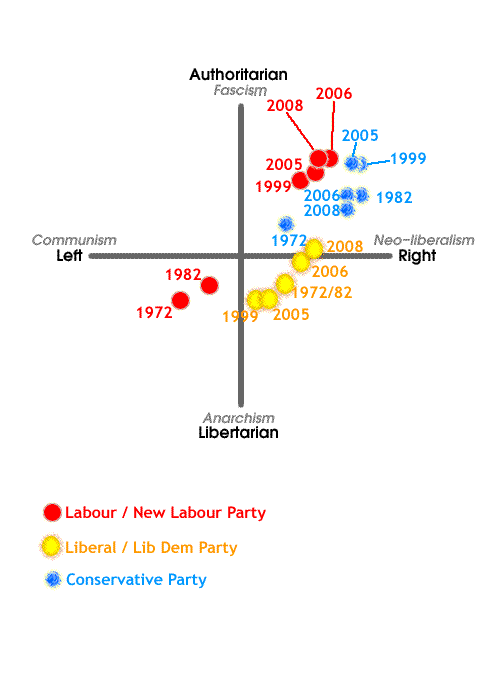
"Right wing" and "left wing" are relative concepts, determined based on where on the left-right spectrum the current political consensus lies. In England, the influence of UKIP (among other factors) has and continues to drag politics ever further to the right, to the extent that we now have a situation where, in many respects, the Conservative Party of the 70s, if it existed today, would be to the left of the current Labour Party. (From a US perspective, where many conservatives hilariously refer to the right-leaning Barack Obama as "socialist", the entire UK political system probably still looks pretty left-wing.)
In Scotland, despite all the claims of the Better Together/Project Fear mob to the contrary, the political climate is substantially different, and the Lib/Lab/Con hegemony that defines Westminster politics doesn't exist. The Tories, while not wholly extinct (yet), are now little more than a protest vote north of border, and the two main parties, between whom every election is primarily contested, are not the Tories and Labour but rather Labour and the SNP. The SNP, despite having attracted the nickname "Tartan Tories" in decades gone by, have long since outflanked Labour on the left, campaigning on a platform that is pro-immigration, social justice, Welfare State and unilateral nuclear disarmament. Scottish Labour, whose policies are designed in their entirety by the broader British Labour Party, find themselves in the unenviable position of having to sell policies decided to appease UKIP supporters to an electorate that is largely social democratic in its principles, if not full-on socialist. This, no doubt, is why so much of what comes out of SLab representatives' mouths is so hopelessly muddled and the calamitous Johann Lamont (SLab's "leader" -- though she has no real power) routinely contradicts herself and has to deny ever saying things that are a matter of record. (Her call to end free universal benefits and her "something for nothing country" comment, which she denies ever having made despite it being available on YouTube for all to see, are a case in point.)
The result of this is that Labour is in terminal decline in Scotland. They may not have suffered a Tory-style wipe-out yet, but I'm convinced that they're well on the road to it. The writing was on the wall in the aftermath of the 2011 Holyrood election, where the SNP won an outright majority in an electoral system that was supposed to prevent such an outcome ever happening, taking seats in areas that had been held by Labour (in Westminster and local elections) for nigh on a century. The "I vote Labour 'cos my da voted Labour" contingent is still substantial, but the party's grip on the electorate is weakening, due to a combination of anger at Blair's lies, the Iraq war and widespread corruption in local politics, and the fact that there's little point in voting for a party whose greatest aspiration is to be minutely less brutal than the Tories when there exists a credible centre-left alternative in the form of the SNP (and smaller parties like the Greens and Scottish Socialists, who have a far better chance of being elected in Holyrood which uses the D'Hondt system of proportional representation than in Westminster with its archaic and profoundly anti-democratic First Past the Post).
If the Tories, Lib Dems and Labour represent the right, centre and left of Westminster politics, then I would argue that the right, centre and left of Scottish politics are effectively represented by Labour, the SNP and Scottish Green Party respectively. (Let's ignore for a moment the fact that the Lib Dems and Tories still have more seats at Holyrood than the Greens -- by demonstrating a willingness to work constructively with the government rather than opposing it for opposition's sake, the Greens have managed to make themselves a far more significant force in Scottish politics. The Equal Marriage Bill, for instance, was carried through parliament by the Greens' Patrick Harvie.)
So Labour are on the left of UK politics but on the right of Scottish politics. (I'm not going to get into Wales and Northern Ireland because I don't know enough about their respective political climates to comment on them.) And yet the dismal Ed Miliband continues to campaign under the spurious "One Nation Labour" banner... nicked, incidentally, from former Tory Prime Minister Benjamin Disraeli. If that slogan is not the perfect illustration that Labour have become the Tories (while the SNP has become Labour, and the Tories have become UKIP, and UKIP have become... well, they've always been a far more dangerous version of the Monster Raving Loony Party, I guess), then I don't know what is.
I'll explain...
"Right wing" and "left wing" are relative concepts, determined based on where on the left-right spectrum the current political consensus lies. In England, the influence of UKIP (among other factors) has and continues to drag politics ever further to the right, to the extent that we now have a situation where, in many respects, the Conservative Party of the 70s, if it existed today, would be to the left of the current Labour Party. (From a US perspective, where many conservatives hilariously refer to the right-leaning Barack Obama as "socialist", the entire UK political system probably still looks pretty left-wing.)
How the parties have shifted since the 70s (courtesy of Political Compass)
In Scotland, despite all the claims of the Better Together/Project Fear mob to the contrary, the political climate is substantially different, and the Lib/Lab/Con hegemony that defines Westminster politics doesn't exist. The Tories, while not wholly extinct (yet), are now little more than a protest vote north of border, and the two main parties, between whom every election is primarily contested, are not the Tories and Labour but rather Labour and the SNP. The SNP, despite having attracted the nickname "Tartan Tories" in decades gone by, have long since outflanked Labour on the left, campaigning on a platform that is pro-immigration, social justice, Welfare State and unilateral nuclear disarmament. Scottish Labour, whose policies are designed in their entirety by the broader British Labour Party, find themselves in the unenviable position of having to sell policies decided to appease UKIP supporters to an electorate that is largely social democratic in its principles, if not full-on socialist. This, no doubt, is why so much of what comes out of SLab representatives' mouths is so hopelessly muddled and the calamitous Johann Lamont (SLab's "leader" -- though she has no real power) routinely contradicts herself and has to deny ever saying things that are a matter of record. (Her call to end free universal benefits and her "something for nothing country" comment, which she denies ever having made despite it being available on YouTube for all to see, are a case in point.)
The result of this is that Labour is in terminal decline in Scotland. They may not have suffered a Tory-style wipe-out yet, but I'm convinced that they're well on the road to it. The writing was on the wall in the aftermath of the 2011 Holyrood election, where the SNP won an outright majority in an electoral system that was supposed to prevent such an outcome ever happening, taking seats in areas that had been held by Labour (in Westminster and local elections) for nigh on a century. The "I vote Labour 'cos my da voted Labour" contingent is still substantial, but the party's grip on the electorate is weakening, due to a combination of anger at Blair's lies, the Iraq war and widespread corruption in local politics, and the fact that there's little point in voting for a party whose greatest aspiration is to be minutely less brutal than the Tories when there exists a credible centre-left alternative in the form of the SNP (and smaller parties like the Greens and Scottish Socialists, who have a far better chance of being elected in Holyrood which uses the D'Hondt system of proportional representation than in Westminster with its archaic and profoundly anti-democratic First Past the Post).
If the Tories, Lib Dems and Labour represent the right, centre and left of Westminster politics, then I would argue that the right, centre and left of Scottish politics are effectively represented by Labour, the SNP and Scottish Green Party respectively. (Let's ignore for a moment the fact that the Lib Dems and Tories still have more seats at Holyrood than the Greens -- by demonstrating a willingness to work constructively with the government rather than opposing it for opposition's sake, the Greens have managed to make themselves a far more significant force in Scottish politics. The Equal Marriage Bill, for instance, was carried through parliament by the Greens' Patrick Harvie.)
So Labour are on the left of UK politics but on the right of Scottish politics. (I'm not going to get into Wales and Northern Ireland because I don't know enough about their respective political climates to comment on them.) And yet the dismal Ed Miliband continues to campaign under the spurious "One Nation Labour" banner... nicked, incidentally, from former Tory Prime Minister Benjamin Disraeli. If that slogan is not the perfect illustration that Labour have become the Tories (while the SNP has become Labour, and the Tories have become UKIP, and UKIP have become... well, they've always been a far more dangerous version of the Monster Raving Loony Party, I guess), then I don't know what is.
Labels:
barack obama,
benjamin disraeli,
conservatives,
ed miliband,
greens,
holyrood,
johann lamont,
labour,
patrick harvie,
politics,
project fear,
scotland,
snp,
ssp,
tony blair,
ukip,
westminster
Subscribe to:
Posts (Atom)