As the 2015 general election approaches, we've been getting voting intention polls on an almost daily basis. All seem to agree that the two "main" UK parties, Labour and the Tories, are hovering somewhere around the dismally low 30% mark. In Scotland, as I've blogged about previously, the picture is quite different, with the SNP, perceived as the "losers" following the defeat of the independence referendum, steamrollering ahead into first place. Virtually every single poll released has placed them ahead of Labour in terms of Westminster voting intentions -- a shocking turnaround, given that Scottish voters, however they might vote at Holyrood and local elections, tend to coalesce around Labour when it comes to Westminster elections. Still, there's now so much polling evidence that it seems impossible to avoid the fact that a shift has occurred in Scottish politics and that voters are now looking more and more to the SNP to stand up for their interests in London.
Today's poll, commissioned by STV and carried out by Ipsos Mori, puts the SNP on 52% of the vote -- i.e. more than that of every other party combined. For a party that polled just 19.9% of the vote in the 2010 election (albeit with a very different picture in the Holyrood election the following year), such a result would be nothing short of remarkable, and it must be stressed that this poll is at the extreme end when it comes to favouring support for the party. Indeed, I'm slightly suspicious of this succession of stories all predicting a near wipeout for Slab. I can't help but thinking that they're preparing the ground for being able to spin anything less than total annihilation as a victory for Labour's northern branch office.
Nonetheless, if these numbers were to prove accurate on polling day, this is what the Scottish electoral map would look like:
Source: STV News
As someone who desperately wants to see Labour and the Lib Dems punished for the myriad of offences they have committed in recent years -- not least (in Labour's case) the unlawful invasion of Iraq and the heinous actions both parties and the Tories committed during the independence referendum in order to secure a No vote that was, in my opinion, unfairly won -- such a prospect fills me with absolute glee. Quite apart from the schadenfreude angle, however, a large contingent of SNP MPs in Westminster would be good not just for Scotland but for the whole of the UK. They are by far the most progressive and left-wing of the large parties (the Greens are further to the left, but, much as I admire their ideals, the level of support they currently command just isn't going to translate into more than a seat or two UK-wide, more's the pity), and today the party's leader, First Minister Nicola Sturgeon, signalled that they were prepared to abandon their long-held convention of not voting on matters devolved to the Scottish parliament. This, she said, means that if a bill was put to the house that would restore the English NHS to public hands, then the SNP would vote for it.
It's a curious state of affairs that the party whose raison d'etre has, since its inception, been to dissolve the Union could end up coming to the aid of the rest of the UK. Because let's be honest, they'll do more good than a similar number of Labour troughers ever will. So take heart, progressives in England, Wales and Northern Ireland: help could be on the way. As I've said before, we live in interesting times.
Showing posts with label westminster. Show all posts
Wednesday, 21 January 2015
Terrible, terrible damage
Labels:
conservatives,
greens,
labour,
liberal democrats,
nicola sturgeon,
politics,
scotland,
snp,
stv,
troughers,
uk,
westminster
Is that a Trident in your pocket, or are you just pleased to see me?*
Every year, the block of SNP, Plaid Cymru and Green MPs get one day to set the agenda for the Westminster Parliament. Today was that day, and they chose to table the motion calling for the non-renewal of Trident -- a position I wholeheartedly support. Quite apart from its very existence being an obscenity, it is utterly ludicrous to contemplate pouring upwards of £100 billion into replacing a weapons system that, by its very nature, can never be used, when public services are being cut left, right and centre, a new food bank is popping up seemingly every time you blink, and public spending has been reduced to pre-war levels. To add insult to injury, these weapons are housed mere miles from Scotland's most populous city. My city. Oh well, at least if something were to go wrong, I'd probably be killed instantly.
The picture above shows how many MPs could be arsed to show up to the debate.
Labour's official line was that it was abstaining from what it called a "meaningless" debate. In reality, this was simply an act to save face, allowing them to avoid having their party's pro-Trident policy subjected to scrutiny, thereby dodging the issue in typical Red Tory fashion. Of course, that didn't stop them and the original Tories -- the blue ones -- from showing up in large numbers for the actual vote, ensuring that it was resoundingly defeated by 364 to 35.
A handful of Labour MPs, on both sides of the argument, did bother to turn up to the debate. In addition to the ever-reliable Dennis Skinner (the only MP who appears to treat his job as an actual job and turns up to work every day), Joan Ruddock, MP for Lewisham Deptford, gave a particularly impressive speech (viewable in two parts here and here). All in all, though, it was an utterly dismal showing, committing the UK to spending a fortune on a new generation of weapons of mass slaughter (and that is exactly what they are, designed to inflict as many civilian casualties as possible -- any "destruction" that occurs is merely a by-product) when families are struggling to put food on the table.
If you can stomach it, you can read the full transcript of the debate here, along with the Hall of Fame (those who voted for the motion) and Hall of Shame (those who voted against). In the interests of brevity, I'll simply record the names and constituencies of all Scottish MPs who bothered to turn up:
FOR
Katy Clark (Lab) - North Ayrshire and Arran
Michael Connarty (Lab) - Linlithgow and East Falkirk
Mike Crockart (Lib Dem) - Edinburgh West
Ian Davidson (Lab) - Glasgow South West
Stewart Hosie (SNP) - Dundee East
Mark Lazarowicz (Lab) - Edinburgh North and Leith
Angus MacNeil (SNP) - Na h-Eileanan an Iar
Fiona O'Donnell (Lab) - East Lothian
Sandra Osborne (Lab) - Ayr, Carrick and Cumnock
Angus Robertson (SNP) - Moray
Mike Weir (SNP) - Angus
Eilidh Whiteford (SNP) - Banff and Buchan
Pete Wishart (SNP) - Perth and North Perthshire
AGAINST
Willie Bain (Lab) - Glasgow North East
Russell Brown (Lab) - Dumfries and Galloway
Margaret Curran (Lab) - Glasgow East
Thomas Docherty (Lab) - Dunfermline and West Fife
Brian Donohoe (Lab) - Central Ayrshire
Gemma Doyle (Lab) - West Dunbartonshire
Michael McCann (Lab) - East Kilbride, Strathaven and Lesmahagow
Gregg McClymont (Lab) - Cumbernauld, Kilsyth and Kirkintilloch East
Anne McGuire (Lab) - Stirling
Iain McKenzie (Lab) - Inverclyde
David Mundell (Con) - Dumfriesshire, Clydesdale and Tweeddale
Pamela Nash (Lab) - Airdrie and Shotts
Alan Reid (Lib Dem) - Argyll and Bute
Jim Sheridan (Lab) - Paisley and Renfrewshire North
I hope the electorate remember how their elected representatives voted when 7th May comes around.
* Because ultimately, it really is nothing more than a penile extension, right?
The picture above shows how many MPs could be arsed to show up to the debate.
Labour's official line was that it was abstaining from what it called a "meaningless" debate. In reality, this was simply an act to save face, allowing them to avoid having their party's pro-Trident policy subjected to scrutiny, thereby dodging the issue in typical Red Tory fashion. Of course, that didn't stop them and the original Tories -- the blue ones -- from showing up in large numbers for the actual vote, ensuring that it was resoundingly defeated by 364 to 35.
A handful of Labour MPs, on both sides of the argument, did bother to turn up to the debate. In addition to the ever-reliable Dennis Skinner (the only MP who appears to treat his job as an actual job and turns up to work every day), Joan Ruddock, MP for Lewisham Deptford, gave a particularly impressive speech (viewable in two parts here and here). All in all, though, it was an utterly dismal showing, committing the UK to spending a fortune on a new generation of weapons of mass slaughter (and that is exactly what they are, designed to inflict as many civilian casualties as possible -- any "destruction" that occurs is merely a by-product) when families are struggling to put food on the table.
If you can stomach it, you can read the full transcript of the debate here, along with the Hall of Fame (those who voted for the motion) and Hall of Shame (those who voted against). In the interests of brevity, I'll simply record the names and constituencies of all Scottish MPs who bothered to turn up:
FOR
Katy Clark (Lab) - North Ayrshire and Arran
Michael Connarty (Lab) - Linlithgow and East Falkirk
Mike Crockart (Lib Dem) - Edinburgh West
Ian Davidson (Lab) - Glasgow South West
Stewart Hosie (SNP) - Dundee East
Mark Lazarowicz (Lab) - Edinburgh North and Leith
Angus MacNeil (SNP) - Na h-Eileanan an Iar
Fiona O'Donnell (Lab) - East Lothian
Sandra Osborne (Lab) - Ayr, Carrick and Cumnock
Angus Robertson (SNP) - Moray
Mike Weir (SNP) - Angus
Eilidh Whiteford (SNP) - Banff and Buchan
Pete Wishart (SNP) - Perth and North Perthshire
AGAINST
Willie Bain (Lab) - Glasgow North East
Russell Brown (Lab) - Dumfries and Galloway
Margaret Curran (Lab) - Glasgow East
Thomas Docherty (Lab) - Dunfermline and West Fife
Brian Donohoe (Lab) - Central Ayrshire
Gemma Doyle (Lab) - West Dunbartonshire
Michael McCann (Lab) - East Kilbride, Strathaven and Lesmahagow
Gregg McClymont (Lab) - Cumbernauld, Kilsyth and Kirkintilloch East
Anne McGuire (Lab) - Stirling
Iain McKenzie (Lab) - Inverclyde
David Mundell (Con) - Dumfriesshire, Clydesdale and Tweeddale
Pamela Nash (Lab) - Airdrie and Shotts
Alan Reid (Lib Dem) - Argyll and Bute
Jim Sheridan (Lab) - Paisley and Renfrewshire North
I hope the electorate remember how their elected representatives voted when 7th May comes around.
* Because ultimately, it really is nothing more than a penile extension, right?
Labels:
bullshit,
conservatives,
dennis skinner,
elections,
glasgow,
greens,
joan ruddock,
labour,
plaid cymru,
snp,
troughers,
weapons of mass destruction,
westminster
Sunday, 30 November 2014
State of the nation
On the 18th September 2014, approximately 45% of Scotland's population voted for independence. A minority, yes, but a significant one. You'd think, then, that with such a vast number of people all supporting a similar cause, there would be a number of pro-independence newspapers to support their viewpoint -- just as there are newspapers that support the Tories or Labour -- right?
Last week, that gulf narrowed in a small but significant way with the introduction of the first weekly newspaper to explicitly support independence, The National. When it came out for Yes, the Sunday Herald defied all expectations and achieved something that no other newspaper has managed for a very long time indeed: it increased its sales figures. Not merely increased them, but DOUBLED them. Sensing that they were on to a good thing, the publishers behind the Herald and Sunday Herald, NewsQuest, decided to commission a pro-independence weekly using the same editorial team and most of the same contributors. What started off as a week-long trial run was confirmed on Friday to continue indefinitely as the paper broke all expectation in terms of sales figures. In fact, it proved so popular that, by as early as Tuesday, the publisher doubled its print run. There is a healthy appetite, it seems, for a paper that explicitly supports the concept of independence and challenges the establishment narrative.
You'd be wrong. Throughout the independence campaign, just one single newspaper supported a Yes vote, and it wasn't even a daily. It was the weekly Sunday Herald, whose sister publication, the Herald, published Monday-Saturday, ultimately backed a No vote, as did the vast majority of the newspapers published in Scotland, either explicitly or implicitly. (The Scottish Sun was one of the only newspapers to make a resolute declaration of neutrality at the eleventh hour.) Almost half the country's population had their opinion reflected by a single weekly paper. A scandalous state of affairs, as I imagine most sane people would agree.
Last week, that gulf narrowed in a small but significant way with the introduction of the first weekly newspaper to explicitly support independence, The National. When it came out for Yes, the Sunday Herald defied all expectations and achieved something that no other newspaper has managed for a very long time indeed: it increased its sales figures. Not merely increased them, but DOUBLED them. Sensing that they were on to a good thing, the publishers behind the Herald and Sunday Herald, NewsQuest, decided to commission a pro-independence weekly using the same editorial team and most of the same contributors. What started off as a week-long trial run was confirmed on Friday to continue indefinitely as the paper broke all expectation in terms of sales figures. In fact, it proved so popular that, by as early as Tuesday, the publisher doubled its print run. There is a healthy appetite, it seems, for a paper that explicitly supports the concept of independence and challenges the establishment narrative.
Myself, I took advantage of the rather generous digital subscription offer of a week's worth of issues (i.e. five -- the paper doesn't publish on Saturdays and Sundays) for £1.50. I'm not, by any stretch of the imagination, an avid newspaper reader. For as long as I've had any interest in current affairs, I've been able to get all the information I need online, which I find vastly preferable to picking up a physical paper -- not just because it's less cumbersome to read and I don't get ink on my fingers, but also because it means I can get my information from a variety of sources instead of being restricted to the editorial line of a single publication. In fact, before the Sunday Herald started supporting independence, the only times I'd ever bought a paper were when I was looking for job advertisements. I bought the Sunday Herald most weeks more as a means of supporting the endeavour than because I had any intention of reading it cover to cover (most of their articles are available online anyway), and have decided to do the same with the National. In fact, I just took out a three-month subscription to the digital edition for a very reasonable £16.99.
As far as its content goes, someone -- accurately, I feel -- described it as essentially a Scottish, pro-independence version of the i Newspaper. It's more or less a tabloid, albeit not of the cheap, tawdry variety -- there are no Page 3 girls, for instance, and celebrity gossip is more or less non-existent. (The covers are really its most sensationalist aspect.) The style is accessible, with clear, direct language and lots of large pictures. A few advertisements too, at the moment mostly for pro-Yes outfits like Glasgow's Yesbar and Deacon Blue's upcoming tour, though that appears to be changing, with Friday's edition having been expanded from 32 to 40 pages because of an increase in advertisers wanting to hawk their wares within its covers. Starting tomorrow there's even a crossword puzzle, along with cartoons from the brilliant Greg Moodie. The content is overwhelmingly focused on Scotland and Scottish politics in particular, but there is a decent amount of international content as well. I particularly like the inclusion of a profile of a different world leader each day.
It seems bizarre to be celebrating the fact that independence now has the backing of 3% of the print media, but that's the situation we're living with. Whereas Catalonia has its own television networks and press, which are able to take a pro-independence line, Scotland has for a long time been extremely poorly served by its media, with the establishment (i.e. Westminster, unionist) line being piped in on a daily basis... and nowhere was this more apparent than during the final two-week anti-independence blitzkreig, where the BBC News channel essentially turned into a 24-hour rolling propaganda broadcast, prompting at least one former contributor to condemn it for its Pravda-esque antics. 3% vs. 97% is still a sad indictment of our media, but the tectonic plates are shifting. Where the National has led the way, other publications like the Scottish Independent and Scottish Statesman look set to follow. The times they are a-changing...
Labels:
bbc,
catalonian independence,
deacon blue,
greg moodie,
herald,
i,
newspapers,
scotland,
scottish independence,
scottish independent,
scottish statesman,
sunday herald,
the national,
westminster,
yesbar
Saturday, 15 November 2014
Changing of the guard
Yesterday, the first day of the SNP's annual party conference in Perth, saw the reins of party leader formally handed over from Alex Salmond to Nicola Sturgeon, in what was easily the most seamless transition of power I've ever witnessed. I'm certainly struggling to think of any other political leader in recent history elected on 100% of her party's vote... though it certainly helped that no-one was foolhardy enough to stand against her.
Sturgeon and Salmond share similar backgrounds. Born in a council house (in Prestwick rather than Linlothgow), she attended a state school and benefited from a free university education (she studied Law at Glasgow University, while Salmond studied Economics at St. Andrews') and joined the SNP at the age of 16 (she was already a member of the CND). She has always been an incredibly shrewd and capable political operator, and opponents underestimate her at their own peril. For instance, in a now-notorious STV debate, she famously reduced Scottish secretary and supposed "bruiser" Alistair Carmichael (seriously, Google his name and "bruiser" and see how many hits turn up) to a blithering wreck who asked moderator Rona Dougall to intervene on his behalf. (Her weary response -- "Answer the question, Alistair" -- was the icing on the cake.) The unionist parties may like to smugly characterise her election as a "coronation" and point out that she has spent the last seven years being groomed to step into Salmond's shoes, but there's little sense of political nepotism in her appointment -- she really is, by a country mile, the best person for the job.
Sturgeon's ascendancy also leads us to the unprecedented situation of all three major parties being led by women. (I'm including Labour even though, strictly speaking, Westminster MP Anas Sarwar is currently standing in as branch officer following Johann Lamont's applecart-spilling resignation. In any event, Labour's interim Holyrood spokesperson is also a female of the species, Jackie Baillie. And as for the dear old Lib Dems... well, does anyone outside of their own rapidly contracting party even remember who their leader in Scotland is?) I'm not so naive as to suggest that a party being led by a woman is automatically preferable to its being led by a man (just look at Margaret Thatcher, or her spiritual successors, the current leader of the Scottish Tories and the outgoing leader of Scottish Labour), but anything that breaks the political stranglehold of the old boys' club has got to be a step in the right direction. More pertinent, I feel, is that Sturgeon, like Salmond before her, wasn't born into a life of privilege and has got to where she is today through a lot of hard work rather than because she went to the right university and rubbed shoulders with the right people.
Yesterday also saw the party's depute leader elected, with Stewart Hosie coming first with 59% of the vote, from a pool of three candidates. The only Westminster MP to stand for the position, Hosie was my first choice (the election used the single transferrable vote system, allowing you to rank candidates in order of preference), primarily because he's a very smooth, capable operator who comes across extremely well whenever he's interviewed. He strikes me as a hard man to rattle, which is good because he'll no doubt be spending a lot more time in the glare of the media spotlight from now on. There is another advantage, though: it gives the SNP a more prominent profile in Westminster -- something that will no doubt be required if the party is to be successful in its stated goal of winning a majority of Scottish seats in the 2015 election. It also allows Sturgeon the opportunity to choose her own Deputy First Minister for the Holyrood parliament -- effectively two for the price of one.
I'm incredibly sad to see Alex Salmond go, and a part of me still wishes he could have been talked out of falling on his sword. He's been such a staple of Scottish political life for so long that the thought of someone else standing at the dispatch box is genuinely difficult to get my head around. There's also the principle of the matter: Salmond has behaved with integrity throughout his political life, and it seems mighty unfair that someone of his character is stepping down while the assorted pirates and cutthroats of the LibLabCon "Better Together" alliance are (for now, anyway) congratulating themselves and each other on a smear campaign well done and/or being measured for their ermine robes. (Little known fact: he donates a third of his salary to charity every year. The fact that he has never publicised this says a lot about the sort of person he is.) That said, it's becoming increasingly clear that, despite standing down as party leader and First Minister, he has no intention of disappearing into the shadows. And it strikes me that a renegade Salmond, unshackled from the responsibilities of First Minister, could well prove to be far more of a thorn in the side of the British state than he ever was in office.
Labels:
alex salmond,
anas sarwar,
cnd,
conservatives,
holyrood,
johann lamont,
labour,
liberal democrats,
margaret thatcher,
nicola sturgeon,
politics,
scottish independence,
snp,
stewart hosie,
stv,
westminster
Thursday, 30 October 2014
I guess that's the "English Votes for English Laws" issue settled, then
Seat projections for the Westminster 2015 election based on the results of today's IPSOS MORI poll.
Memo to Labour: if you lie (in both senses of the word) with the Tories, be prepared to be treated like Tories.
Labels:
elections,
labour,
politics,
schadenfreude,
snp,
westminster
Saturday, 25 October 2014
Ding dong...
I woke up this morning to the news that Johann Lamont, "leader" of "Scottish" Labour, had resigned with immediate effect, giving an exclusive interview in the party's house journal, the Daily Record. In doing so, she has become the fourth SLab leader in a row to be seen off by Alex Salmond since he became First Minister in 2007. This just shy of a month after giving an interview to the same newspaper in which, following mounting speculation that the knives were being sharpened for her, she insisted that she was going nowhere and proclaimed her ambition to be the next First Minister. (OK, stop laughing...)
Artist's impression of Lamont's political fortunes
in the Yes-supporting Sunday Herald last week.
With her excruciating performances on Thursday mornings at First Minister's Questions and a knack for soundbite gaffes that would make George W. Bush blush, Lamont never appeared comfortable in the role of party leader, and has looked like a (political) dead woman walking for at least the last year. She also came across, either as a result of her actual personality or the scripts prepared for her by her spin doctors, as a bitter, spiteful individual -- a perception given credence by the hand grenade she lobbed at the party's Westminster leadership on her way out the door. She claims to be sick of being overruled by London, whom she accuses of running the Scottish division as little more than a regional branch office, and of failing to understand that Scotland's political centre is now Holyrood, not Westminster. (We could have told you that, Johann.)
That's right, the woman who campaigned so strenuously for Scotland to remain governed by Westminster has resigned because she doesn't like being governed by Westminster. I presume she doesn't "do" irony.
In my view, Lamont's departure is both a blessing and a curse to the Yes side. A blessing, because she leaves SLab in such a state of utter turmoil that it's difficult to see how it can recover. There is no heir apparent to her "crown" -- calling the talent on the Labour benches at Holyrood third rate would be overly charitable, and her accusations of London interference means that any "big hitter" parachuted in from the Westminster benches is going to have about as much credibility as... well, Johann Lamont. On the other hand, Lamont's ineptitude has long been viewed as a gift to the SNP. Truly, she was so poor that whoever replaces her can't help but look better by comparison. Then again, much the same was said of her predecessor Iain Gray...
One thing's for sure, I doubt the BBC's James Cook had any idea he was writing the epitaph for Lamont's career when he made this observation to her on a panel show back in August:
Labels:
alex salmond,
daily record,
holyrood,
iain gray,
james cook,
johann lamont,
labour,
politics,
snp,
westminster
Friday, 17 October 2014
The shifting sands
Today is a momentous day. Today, polling companies YouGov and Populous each released data on Scottish voting intentions for the 2015 Westminster election. That in itself is hardly newsworthy, as polls like these are two a penny. What IS interesting is the numbers. As with most recent polls of this sort, both give the SNP a clear lead. Quite jaw-dropping, however, is the fact that both also place Labour in third place, behind the Tories.
YouGov:
SNP - 41%
Conservatives - 20%
Labour - 19%
Liberal Democrats - 9%
UKIP - 6%
Greens - 5%
Populous:
SNP - 35%
Conservatives - 24%
Labour - 21%
Liberal Democrats - 10%
Greens - 4%
UKIP - 4%
Source
It's important to stress that the Tory vote hasn't risen in any meaningful way. They remain as toxic as always in Scotland, where they've never recovered from the backlash they suffered as a result of their policies in the 1980s, most notably using Scotland as a guinea pig to test out the Poll Tax a full year before unleashing it on the rest of the UK. What has happened instead is that the Labour vote appears to be in freefall, dropping to a record low of 19% in the YouGov sample and 21% in the Populous sample. This in a country where, until recently, the joke was that you didn't count Labour votes -- you weighed them.
Something I really found fascinating about the referendum was the apparent eagerness with which Labour willingly put themselves forward as the Tories' foot soldiers. Because make no mistake, the No campaign was bankrolled by Tories, with a Tory prime minister its de facto commander, relying on the Labour campaign machine to carry its message to the masses. In doing so, Labour not only made itself interchangeable with its supposed sworn enemy, it also cemented its position as the party that did Scotland down. The sheer amount of footage that exists of well-known Labour faces poo-pooing a country's hopes and aspirations is quite ming-boggling, and I suspect that even hardened No voters will have a hard time forgetting this, let alone the sight of Labour and Tory politicians linking arms to dance and cheer as the results were announced in the early hours of the 19th of September.
The Scottish Statesman, a pro-Yes online newspaper that has emerged from the ashes of the referendum defeat, has a really interesting article on the changing fortunes of the Labour Party in Scotland, suggesting that, "in blunt terms, Labour is toast." Well worth a read.
Labels:
conservatives,
labour,
politics,
scottish independence,
snp,
westminster
Friday, 3 October 2014
What now?
I've deliberately avoided writing about the Scottish independence issue for the last week or so. I spent most of the weekend following the referendum feeling numb, angry and completely hopeless, with the double whammy of losing the vote followed shortly afterwards by Alex Salmond's snap decision not to stand for re-election as leader of the SNP in November leaving me devastated. (And how galling it was to watch the man who'd safeguarded our NHS, delivered free prescriptions, university tuition and care for the elderly announcing his resignation, while war criminals, expenses frauds and proven liars smirked and patted themselves on the back.) I wanted to take some time to let my emotions settle and to mull over the main question that must be on every single pro-independence campaigner's mind -- namely "What now?"
It seems reasonable to suggest that the independence movement will not go quietly into the night. In fact, I've been surprised by just how quickly so many people came to terms with the crushing despair of having lost the referendum and immediately began to regroup, speculating as to what the next step should be for the movement. It will undoubtedly change in terms of its immediate goals and tactics, but the long term aim -- independence for Scotland -- remains firmly on the agenda. It certainly remains my aim, though I'm pragmatic enough to assume that, at present, it's off the menu for at least a few years. The people have spoken, and all that. Many of them may have been cajoled, intimidated and deceived into voting No, but vote No they did, and as democrats we have to accept (I almost typed "respect", but decided against it) the result.
That said, I was intrigued that Nicola Sturgeon, when launching her bid for leadership of the SNP (and there can be little doubt that she'll succeed, given that so far no-one has come forward to challenge her, with every other potential candidate giving her their backing), refused to rule out calling another referendum in the future. It would be absurdly unwise for the SNP to go into the next election with the promise of another referendum in their manifesto -- I expect they would be slaughtered at the ballot box by an electorate that's had its fill of rederenda after two and a half years of argument -- but keeping it on standby as a potential weapon to whip out in the event of a dramatic change of circumstances is a wise move.
What would constitute such a change of circumstances? Well, for one thing, the three Westminster parties reneging on the vows they dreamt up on the back of a fag packet in the final weeks of the campaign. For another, the looming EU in/out referendum the Conservatives are promising in 2017. If a scenario were to emerge whereby England voted by majority to leave the EU and Scotland voted by majority to remain (as the polls tend to suggest), then in my view the Scottish Government would be entirely justified in calling a snap independence referendum on the grounds that the tectonic plates had shifted. And they'd probably win it comfortably.
In the meantime, the SNP's immediate goal appears to be holding Westminster to account over the grandiose promises it made in the run-up to the vote. The words "DevoMax" and "federalism" were trotted out several times -- words with specific meanings, but which both the politicians and the media cynically used to make what they were offering sound more impressive than it actually was. "DevoMax", for the avoidance of any doubt, means maximum devolution, i.e. full control of all matters except defence and foreign affairs. Nothing the three Westminster parties have offered (and all are proposing different packages, with Labour's by far the most feeble) comes even remotely close to fulfilling those criteria, but DevoMax we were promised, so DevoMax we will demand. There can be little doubt that Sturgeon will be all too willing to remind them of the language they used when the negotiations begin.
Apparently, in the most recent issue of the Sun on Sunday, David Cameron stated a desire to give Scotland the power to raise and spend all its own money. I have my doubts that he really means this, as it would mean saying goodbye to all those lovely oil revenues. However, let's take these comments at face value for a moment. Realistically speaking, Cameron has little to lose by offering Scotland as much autonomy as possible. There is, after all, only a single Tory MP north of the border, so in a sense Scotland is already a write-off from the Conservative Party's point of view. Any significant transfer of powers would undoubtedly mean reducing Scotland's presence at a UK parliamentary level to compensate, but something tells me Cameron wouldn't lose much sleep over axing a single MP. On the other hand Labour, with its 40 Scottish MPs (at least until the 2015 general election), has far more to lose, which probably explains why Labour's devolution proposals are so toothless. Indeed, Cameron's "English votes for English laws" drive, announced the morning after the referendum in his victory speech, looks more and more like a cunning trap laid for Ed Miliband and his party.
(Incidentally, I have absolutely no problem with the idea of "English votes for English laws", and indeed I commend the SNP's Westminster MPs for adopting the principled stance of not voting on matters that are devolved to the Scottish parliament. That said, there are certain caveats, the most significant one being that the budget Scotland receives is set by Westminster, and a situation could potentially arise whereby Scottish MPs are unable to vote on motions that impact on the Scottish budget.)
Allow me some pie-in-the-sky thinking for a moment. Imagine a scenario by which the UK moved to a truly federal settlement whereby each of the four nations was completely financially autonomous. If such a situation came to pass, then in many respects the question of independence becomes a moot point. I'm not a hard line Scottish nationalist, and wouldn't have too much of a problem with the idea of a union called the United Kingdom continuing in some form, provided Scotland was allowed to govern its own affairs within that union. The only downside (and it is a major one, I admit) is that it does nothing to extricate us from the UK's disastrous foreign policy or resolve the presence of nuclear warheads just miles from our most populous city. That's why, at the end of the day, while I would take DevoMax or federalism as the next best thing, it's still a lesser alternative to true independence, which I believe must remain the ultimate goal. For the time being, though, I believe the immediate task must be to, as Alex Salmond put it, "hold Westminster's feet to the fire" and ensure that they deliver on their promises.
Crucial to this is going to be getting as many pro-independence MPs sent to Westminster in the 2015 general election as possible. Scotland currently has 59 MPs, of whom a mere six are SNP. The rest consist of 40 Labour, 11 Liberal Democrats, and a solitary Tory in the rather weird Dumfriesshire, Clydesdale and Tweeddale constituency. The Lib Dems are, it's safe to assume, pretty much toast, barring in their strongholds in the Highlands and Islands, so the main priority must surely be to unseat as many Labour troughers as possible. That's a hard ask -- many of them have massive majorities, and in many constituencies the SNP came third or fourth in the most recent general election. Nothing would give me greater pleasure than to see Labour annihilated in Scotland -- words cannot express how much I despise them and the way they cynically wrap themselves in the flag of social justice while doing nothing to alleviate the poverty the blights their strongholds -- but I'm pragmatic enough to accept that this is unlikely. The "ah vote Labour cuz ma da voted Labour" force is still strong.
That said, the ground appears to be shifting. The Labour citadels of Glasgow and North Lanarkshire both voted Yes by majority (in fact, every single constituency in Glasgow recorded an overall Yes vote), so it may be that the idea of the safe Labour seat is coming to an end. YouGov president Peter Kellner published an interesting article the other day speculating as to the likely makeup of the 2015 parliament, going to far as to suggest that the SNP could potentially hold the balance of power in the same way that the Liberal Democrats did in 2010. If that's the case, then the main precondition for any sort of coalition or confidence and supply arrangement must be a guarantee of full DevoMax.
When 2016 and the Scottish elections swing around, the picture is slightly different. The SNP already hold an absolute majority in the Scottish parliament under a system of proportional representation -- an anomaly that was never supposed to happen. It's feasible that they could return to being a minority government, which they previously managed successfully between 2007 and 2011, but I wouldn't like to suggest that a second majority is completely out of the question. It's certainly highly unlikely, barring some sort of scandal that rocks the incumbent government, that Labour will be back in power in 2016, and as for the Tories and Lib Dems -- forget it. The Tories might just cling on, as there's a core bloc that continues to vote for them come hell or high water, but the Lib Dems have already been reduced to a rump of five MSPs, and are for all intents and purposes irrelevant. The Greens currently only have two MSPs, but they stand a strong chance of increasing their presence, and the fact that the vast majority of their new members will be disillusioned Yes voters (membership has trebled since the referendum) means that the party is unlikely to abandon the pro-independence stance that it only reached after considerable internal debate.
So for the time being, the primary goal seems to be to pack both parliaments with as many pro-Yes MPs and MSPs as possible, and to use that position to agitate for a far more impressive package of new powers than what any of the three Westminster parties are currently proposing. I believe we should dismiss any thought of planning to hold another referendum in the immediate future, but to retain it as an option should (a) Westminster renege on its vows and/or (b) we find ourselves being dragged out of the EU against our will. The matter of independence has not, despite the wishes of the No campaign, been settled, and it's entirely possible that we could find ourselves at the ballot box once again within the next decade.
UP NEXT: My thoughts on why the Yes campaign failed.
Labels:
alex salmond,
conservatives,
david cameron,
devomax,
ed miliband,
federalism,
holyrood,
labour,
liberal democrats,
nhs,
nicola sturgeon,
politics,
scottish independence,
snp,
westminster
Tuesday, 19 August 2014
The poll you may have missed
With just under a month to go until Scotland votes on whether to remain in the UK or go independent, I'm becoming more and more preoccupied by the outcome. We repeatedly find commentators on TV and in the papers insisting that it's a done deal, that the Yes campaign will be defeated and that pesky Alex Salmond will be sent packing once and for all -- an assertion that they repeat so often and with such insistence that you can tell they desperately hope it's true. Myself, I don't claim to know what the outcome will be. I desperately hope that it's a Yes vote, and the the general impression I get from my colleagues and my own peer group is that that's the way things are headed, but subjective impressions can be very dangerous. My dad, in contrast, is comfortably off and in his 60s, and virtually everyone he knows is a virulent No voter. (He's the sole Yes voice in his wine circle -- and his surprise and disappointment at being the only Yes voter in a wine circle always strikes me as vaguely amusing. It's like coming home from a trade union meeting and expressing surprise that it was dominated by left-wing voices.) Which is unsurprising, because rich, old people are the most No-friendly demographic (the rich because they don't see the need for change, the old because people over the age of 60 traditionally have a much stronger British identity and still remember a time when the standard of living within the union was improving rather than declining).
The point is that you can't just go by your own personal experiences and assume that they hold true for the entire country...
...which is why what the Radical Independence Campaign has been doing is so fascinating. They've been out knocking on doors in the most deprived parts of Scotland, canvassing people on their voting intentions. The results, which never get a lick of airtime in the mainstream media, should be enough to make even the most courageous unionist soil his Union Jack Y-fronts:
It should come as no surprise that support for the union is lowest among those who have the least to lose. These are communities that have been let down by successive Tory and Labour governments, and who in normal elections turn out to vote in depressingly low numbers, because they feel completely disconnected from the political process and believe their vote will make little difference. Except this isn't a normal election -- it's a referendum on the very future of the country, and while the Yes and No camps rarely agree on anything, one thing that both acknowledge is that turnout on the 18th of September is likely to be at unprecedented levels.
This is why I don't put much faith in the "official" polls carried out by the likes of YouGov and Ipsos MORI, all of which have consistently showed a No lead (some fairly strong, others wafer thin). While analysing them can be interesting, and James Kelly over at SCOT Goes POP! does an outstanding job of doing just that, they're all based on guesswork to an extent, with the various pollsters devising complex and often arcane weighting procedures in an attempt to get an accurate result.* Most of these, as far as I can tell, consist of looking at the way people have voted in previous elections and performing various calculations to upweight or downweight respondents accordingly (in addition to other factors like country of birth, social bracket, gender and age). That's all well and good, but what do you do when you have somewhere in the region of a million people who have never voted before but are now expressing a desire to cast their vote on the 18th?
(* What I think these polls DO allow us to do is to identify broad trends. For example, three of the six main pollsters have released polls since Sunday, and all of them show a swing to Yes of between 2 and 4% compared to their previous respective polls. That suggests that some movement from No to Yes has indeed taken place since Alex Salmond and Alastair Darling went head to head on STV. What it doesn't tell us is whether the figures they started out with before the shift took place were remotely accurate.)
As I've said before, I've no idea how the vote is going to go, but if the so-called "missing million" turn out in their droves on polling day, then things could get very interesting.
And for those in the rest of the UK unsure about or opposed to Scottish independence, here's something for you to ponder: a Yes vote will almost certainly lead to the unilateral nuclear disarmament of the UK and could well lead to David Cameron being forced out of office, if not the fall of the entire government. If it was me, I'd be saying:
The point is that you can't just go by your own personal experiences and assume that they hold true for the entire country...
...which is why what the Radical Independence Campaign has been doing is so fascinating. They've been out knocking on doors in the most deprived parts of Scotland, canvassing people on their voting intentions. The results, which never get a lick of airtime in the mainstream media, should be enough to make even the most courageous unionist soil his Union Jack Y-fronts:
Mass canvass figures released 19th August 2014.
It should come as no surprise that support for the union is lowest among those who have the least to lose. These are communities that have been let down by successive Tory and Labour governments, and who in normal elections turn out to vote in depressingly low numbers, because they feel completely disconnected from the political process and believe their vote will make little difference. Except this isn't a normal election -- it's a referendum on the very future of the country, and while the Yes and No camps rarely agree on anything, one thing that both acknowledge is that turnout on the 18th of September is likely to be at unprecedented levels.
This is why I don't put much faith in the "official" polls carried out by the likes of YouGov and Ipsos MORI, all of which have consistently showed a No lead (some fairly strong, others wafer thin). While analysing them can be interesting, and James Kelly over at SCOT Goes POP! does an outstanding job of doing just that, they're all based on guesswork to an extent, with the various pollsters devising complex and often arcane weighting procedures in an attempt to get an accurate result.* Most of these, as far as I can tell, consist of looking at the way people have voted in previous elections and performing various calculations to upweight or downweight respondents accordingly (in addition to other factors like country of birth, social bracket, gender and age). That's all well and good, but what do you do when you have somewhere in the region of a million people who have never voted before but are now expressing a desire to cast their vote on the 18th?
(* What I think these polls DO allow us to do is to identify broad trends. For example, three of the six main pollsters have released polls since Sunday, and all of them show a swing to Yes of between 2 and 4% compared to their previous respective polls. That suggests that some movement from No to Yes has indeed taken place since Alex Salmond and Alastair Darling went head to head on STV. What it doesn't tell us is whether the figures they started out with before the shift took place were remotely accurate.)
As I've said before, I've no idea how the vote is going to go, but if the so-called "missing million" turn out in their droves on polling day, then things could get very interesting.
And for those in the rest of the UK unsure about or opposed to Scottish independence, here's something for you to ponder: a Yes vote will almost certainly lead to the unilateral nuclear disarmament of the UK and could well lead to David Cameron being forced out of office, if not the fall of the entire government. If it was me, I'd be saying:
Thursday, 31 July 2014
A tale of two governments
While the Westminster government continues to sell arms to the Israeli regime, another government 400 miles further north chose to go down a different route:
In addition to being the first Western government to explicitly condemn Israel's recent "collective punishment" of the people of Gaza, the Scottish government is actually putting its money where its mouth is and attempting to do something to alleviate the appalling suffering Gazans are currently experiencing. I know I bang the Scottish independence drum with some regularity on this blog, but situations like this throw into sharp relief the bizarreness of being represented on the world stage by two separate governments -- one that allows me to hold my head high and another that makes me want to simultaneously hang it in shame.
PS. Good piece in the New Statesman by Andrew Smith of the Campaign Against Arms Trade on why the UK must end its military support of Israel.
In addition to being the first Western government to explicitly condemn Israel's recent "collective punishment" of the people of Gaza, the Scottish government is actually putting its money where its mouth is and attempting to do something to alleviate the appalling suffering Gazans are currently experiencing. I know I bang the Scottish independence drum with some regularity on this blog, but situations like this throw into sharp relief the bizarreness of being represented on the world stage by two separate governments -- one that allows me to hold my head high and another that makes me want to simultaneously hang it in shame.
PS. Good piece in the New Statesman by Andrew Smith of the Campaign Against Arms Trade on why the UK must end its military support of Israel.
Labels:
gaza,
israel,
scottish government,
scottish independence,
war crimes,
westminster
Friday, 16 May 2014
Fault lines
Political musing for the day: I'm intrigued by how readily Labour have inherited the mantle of the "nasty party" from the Tories in Scotland.
I'll explain...
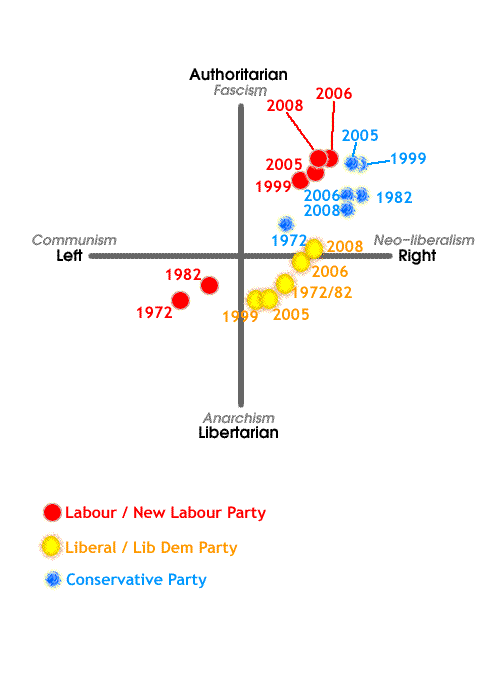
"Right wing" and "left wing" are relative concepts, determined based on where on the left-right spectrum the current political consensus lies. In England, the influence of UKIP (among other factors) has and continues to drag politics ever further to the right, to the extent that we now have a situation where, in many respects, the Conservative Party of the 70s, if it existed today, would be to the left of the current Labour Party. (From a US perspective, where many conservatives hilariously refer to the right-leaning Barack Obama as "socialist", the entire UK political system probably still looks pretty left-wing.)
In Scotland, despite all the claims of the Better Together/Project Fear mob to the contrary, the political climate is substantially different, and the Lib/Lab/Con hegemony that defines Westminster politics doesn't exist. The Tories, while not wholly extinct (yet), are now little more than a protest vote north of border, and the two main parties, between whom every election is primarily contested, are not the Tories and Labour but rather Labour and the SNP. The SNP, despite having attracted the nickname "Tartan Tories" in decades gone by, have long since outflanked Labour on the left, campaigning on a platform that is pro-immigration, social justice, Welfare State and unilateral nuclear disarmament. Scottish Labour, whose policies are designed in their entirety by the broader British Labour Party, find themselves in the unenviable position of having to sell policies decided to appease UKIP supporters to an electorate that is largely social democratic in its principles, if not full-on socialist. This, no doubt, is why so much of what comes out of SLab representatives' mouths is so hopelessly muddled and the calamitous Johann Lamont (SLab's "leader" -- though she has no real power) routinely contradicts herself and has to deny ever saying things that are a matter of record. (Her call to end free universal benefits and her "something for nothing country" comment, which she denies ever having made despite it being available on YouTube for all to see, are a case in point.)
The result of this is that Labour is in terminal decline in Scotland. They may not have suffered a Tory-style wipe-out yet, but I'm convinced that they're well on the road to it. The writing was on the wall in the aftermath of the 2011 Holyrood election, where the SNP won an outright majority in an electoral system that was supposed to prevent such an outcome ever happening, taking seats in areas that had been held by Labour (in Westminster and local elections) for nigh on a century. The "I vote Labour 'cos my da voted Labour" contingent is still substantial, but the party's grip on the electorate is weakening, due to a combination of anger at Blair's lies, the Iraq war and widespread corruption in local politics, and the fact that there's little point in voting for a party whose greatest aspiration is to be minutely less brutal than the Tories when there exists a credible centre-left alternative in the form of the SNP (and smaller parties like the Greens and Scottish Socialists, who have a far better chance of being elected in Holyrood which uses the D'Hondt system of proportional representation than in Westminster with its archaic and profoundly anti-democratic First Past the Post).
If the Tories, Lib Dems and Labour represent the right, centre and left of Westminster politics, then I would argue that the right, centre and left of Scottish politics are effectively represented by Labour, the SNP and Scottish Green Party respectively. (Let's ignore for a moment the fact that the Lib Dems and Tories still have more seats at Holyrood than the Greens -- by demonstrating a willingness to work constructively with the government rather than opposing it for opposition's sake, the Greens have managed to make themselves a far more significant force in Scottish politics. The Equal Marriage Bill, for instance, was carried through parliament by the Greens' Patrick Harvie.)
So Labour are on the left of UK politics but on the right of Scottish politics. (I'm not going to get into Wales and Northern Ireland because I don't know enough about their respective political climates to comment on them.) And yet the dismal Ed Miliband continues to campaign under the spurious "One Nation Labour" banner... nicked, incidentally, from former Tory Prime Minister Benjamin Disraeli. If that slogan is not the perfect illustration that Labour have become the Tories (while the SNP has become Labour, and the Tories have become UKIP, and UKIP have become... well, they've always been a far more dangerous version of the Monster Raving Loony Party, I guess), then I don't know what is.
I'll explain...
"Right wing" and "left wing" are relative concepts, determined based on where on the left-right spectrum the current political consensus lies. In England, the influence of UKIP (among other factors) has and continues to drag politics ever further to the right, to the extent that we now have a situation where, in many respects, the Conservative Party of the 70s, if it existed today, would be to the left of the current Labour Party. (From a US perspective, where many conservatives hilariously refer to the right-leaning Barack Obama as "socialist", the entire UK political system probably still looks pretty left-wing.)
How the parties have shifted since the 70s (courtesy of Political Compass)
In Scotland, despite all the claims of the Better Together/Project Fear mob to the contrary, the political climate is substantially different, and the Lib/Lab/Con hegemony that defines Westminster politics doesn't exist. The Tories, while not wholly extinct (yet), are now little more than a protest vote north of border, and the two main parties, between whom every election is primarily contested, are not the Tories and Labour but rather Labour and the SNP. The SNP, despite having attracted the nickname "Tartan Tories" in decades gone by, have long since outflanked Labour on the left, campaigning on a platform that is pro-immigration, social justice, Welfare State and unilateral nuclear disarmament. Scottish Labour, whose policies are designed in their entirety by the broader British Labour Party, find themselves in the unenviable position of having to sell policies decided to appease UKIP supporters to an electorate that is largely social democratic in its principles, if not full-on socialist. This, no doubt, is why so much of what comes out of SLab representatives' mouths is so hopelessly muddled and the calamitous Johann Lamont (SLab's "leader" -- though she has no real power) routinely contradicts herself and has to deny ever saying things that are a matter of record. (Her call to end free universal benefits and her "something for nothing country" comment, which she denies ever having made despite it being available on YouTube for all to see, are a case in point.)
The result of this is that Labour is in terminal decline in Scotland. They may not have suffered a Tory-style wipe-out yet, but I'm convinced that they're well on the road to it. The writing was on the wall in the aftermath of the 2011 Holyrood election, where the SNP won an outright majority in an electoral system that was supposed to prevent such an outcome ever happening, taking seats in areas that had been held by Labour (in Westminster and local elections) for nigh on a century. The "I vote Labour 'cos my da voted Labour" contingent is still substantial, but the party's grip on the electorate is weakening, due to a combination of anger at Blair's lies, the Iraq war and widespread corruption in local politics, and the fact that there's little point in voting for a party whose greatest aspiration is to be minutely less brutal than the Tories when there exists a credible centre-left alternative in the form of the SNP (and smaller parties like the Greens and Scottish Socialists, who have a far better chance of being elected in Holyrood which uses the D'Hondt system of proportional representation than in Westminster with its archaic and profoundly anti-democratic First Past the Post).
If the Tories, Lib Dems and Labour represent the right, centre and left of Westminster politics, then I would argue that the right, centre and left of Scottish politics are effectively represented by Labour, the SNP and Scottish Green Party respectively. (Let's ignore for a moment the fact that the Lib Dems and Tories still have more seats at Holyrood than the Greens -- by demonstrating a willingness to work constructively with the government rather than opposing it for opposition's sake, the Greens have managed to make themselves a far more significant force in Scottish politics. The Equal Marriage Bill, for instance, was carried through parliament by the Greens' Patrick Harvie.)
So Labour are on the left of UK politics but on the right of Scottish politics. (I'm not going to get into Wales and Northern Ireland because I don't know enough about their respective political climates to comment on them.) And yet the dismal Ed Miliband continues to campaign under the spurious "One Nation Labour" banner... nicked, incidentally, from former Tory Prime Minister Benjamin Disraeli. If that slogan is not the perfect illustration that Labour have become the Tories (while the SNP has become Labour, and the Tories have become UKIP, and UKIP have become... well, they've always been a far more dangerous version of the Monster Raving Loony Party, I guess), then I don't know what is.
Labels:
barack obama,
benjamin disraeli,
conservatives,
ed miliband,
greens,
holyrood,
johann lamont,
labour,
patrick harvie,
politics,
project fear,
scotland,
snp,
ssp,
tony blair,
ukip,
westminster
Subscribe to:
Posts (Atom)