Showing posts with label greens. Show all posts
Friday, 6 May 2016
The new Scotland
Well, that was an interesting night. Against my better judgement, I stayed up for the whole thing, once it became clear that this wasn't going to be a straightforward election by any means. The SNP, as predicted, have won a historic third term in office, albeit missing out on a majority by two seats. A commendable result after nine years in power and 99% of the media against them.
In essence, the Greens' gains came at the expense of the SNP, perhaps most symbolically in Edinburgh Central, where the Greens' Alison Johnstone's hefty 14% share of the vote almost certainly allowed Tory leader Ruth Davidson to scrape past the SNP's Alison Dickie for a win. This was even more apparent on all important regional lists, where the SNP failed to gain enough seats to make up for some surprising losses in the constituency ballot. Seriously, those results in Edinburgh are just bonkers - Lib Dems soaring to 42% in Edinburgh Western while losing their deposits in all other Edinburgh constituencies bar one. The affluent unionist-leaning constituencies have, it seems, mastered the art of tactical voting.
The big story, unsurprisingly, is the Tories coming second, and not just scraping it either, but bagging a whopping 31 seats. I can't say I'm sorry to see Labour crash and burn - they've brought it on themselves and deserve nothing less than a generation (or perhaps a lifetime) in the political wilderness for their behaviour during and since the independence referendum - and in many respects I actually think having a full-blooded Tory opposition rather than a feckless, infantile Labour opposition might actually concentrate people's minds a bit. The main political fault line in Scotland was confirmed last night as being very much one of a left-leaning, progressive "nationalism" versus a cruel, right-wing unionism. At the very least, I hope the Tories in Scotland now face scrutiny for what their masters in London are doing - something Davidson and her cronies have inexplicably managed to avoid to date. I'm just astounded at how readily such a large swathe of Labour voters gaily embraced their supposed mortal enemies... but then, we saw how happily they worked together during the referendum, so perhaps, for a great many of them, these supposedly vast ideological differences really are purely cosmetic.
Ultimately, with the combined SNP and Green seats, we still have a pro-independence majority, and as far as I'm concerned that can only be a good thing. And, though I voted SNP on both ballots, I look forward to seeing whether the Greens are able to use their likely status as kingmakers to steer the SNP in a more radical direction on issues on which they've been rather timid - council tax and land reform, to name a couple. And words cannot express my delight at the fact that, contrary to what some of the polls were suggesting, the repugnant David "Toad of Toad Hall" Coburn failed to make inroads in the Highlands and Islands, meaning that Holyrood remains a UKIP-free zone. And, in spite of early reports from the ground, voter turnout was actually up compared to 2011, reaching an all-time high for Scottish parliamentary elections. Hooray for democracy! I think.
So, once again, to recap my predictions from the other day:
SNP 71 (+2)
Labour 26 (-11)
Tories 21 (+6)
Lib Dems 6 (+1)
Greens 5 (+3)
And in reality...
SNP 63 (-6)
Tories 31 (+16)
Labour 24 (-13)
Greens 6 (+4)
Lib Dems 5 (+0)
Labels:
elections,
greens,
labour,
liberal democrats,
politics,
scotland,
scottish government,
scottish independence,
snp,
tories,
ukip
Wednesday, 4 May 2016
Scottish parliament election musings
So tomorrow we go to the polls... or rather, those who haven’t already voted by post go to the polls. This has been a weird and curiously low-key election — one in which all the major parties, bar the one everyone knows is going to win, effectively conceded defeat several months ago, with the Tories actively campaigning on a “vote for us to be the opposition” ticket. Still, I don’t think the result is a foregone conclusion by any stretch of the imagination. The way the D’Hondt system works, the line between a minority government and an outright majority is a very fine one indeed, and the eventual result will inevitably come down to the precise distribution of the vote in the various constituencies and regions.
I’m not a betting man (though I did buy a lottery ticket once, about 15 years ago — somewhat surprisingly, I didn’t win), but these are my predictions for the outcome. Come Friday, we’ll see how close I was.
- The SNP will win another majority, with a very modest increase on their 2011 result of 69 seats. They will not, as some have predicted, take all the constituency seats. I’m going to take an almighty gamble and predict that Nicola Sturgeon will be First Minister next week.
- Labour will remain the second largest party, but their lead over the Conservatives will be reduced to a handful of seats (say 5). Kezia Dugdale will remain in place as leader, if for no reason other than that you can’t go any lower than rock bottom.
- The Conservatives will make modest gains, picking up some of Labour’s hard unionist vote, but there will be no glorious revival... though the media will continue to inexplicably fawn over the unimpressive Ruth Davidson.
- The Liberal Democrats will gain one more seat than they did in 2011, prompting much chest-beating and claims of a Lib Dem revival from the amusing Willie Rennie. Failing that, they will retain the exact same number of seats as in 2011 and will claim that “the vote held up.” No one will listen because no one takes Willie Rennie seriously.
- The Greens will make respectable gains, albeit not to the extent that many of the polls have predicted. They’ll probably double their 2011 result of 2, but not much beyond that, and as such, will fail to overtake the Lib Dems as the fourth largest party, more’s the pity.
- RISE, Solidarity and UKIP will all fail to win a single seat. David Coburn will be deposed as UKIP leader.
So (and in the famous last words of Paddy Ashdown, I’ll eat my hat if this poll is accurate), here are my guesses:
SNP 71 (+2)
Labour 26 (-11)
Tories 21 (+6)
Lib Dems 6 (+1)
Greens 5 (+3)
Labels:
conservatives,
elections,
greens,
labour,
liberal democrats,
nicola sturgeon,
politics,
rise,
scotland,
scottish government,
snp,
ukip
Sunday, 10 May 2015
A tale of two elections
"My God, what have we just done?"
I'll be upfront about it: that was my immediate, instinctive reaction when the exit poll was published at 10 PM on Thursday night. At that point, I wasn't looking at the Tories and Labour's share of seats. They barely even registered on my radar, so convinced was I by the media narrative that there would only be a handful of seats between them either way. All that mattered to me at that point was to see how well the SNP were set to do, and when I saw that number -- a projected 58 out of 59 seats -- a shiver went up my spine as it hit me how seismic this event was. To put it bluntly, the swing was so extreme that it scarcely seemed possible and the challenge to the accepted orthodoxy so brazen that I half-expected divine retribution (or whatever the atheistic equivalent is) to be imminent.
I'll turn to the not so little issue of the UK-wide results and their implications later. For the time being, to hammer home just how truly remarkable the death of Scottish Labour and rise of the SNP is, take a look at this graph showing the share of Scottish seats in every general election since 1955:
I'll be upfront about it: that was my immediate, instinctive reaction when the exit poll was published at 10 PM on Thursday night. At that point, I wasn't looking at the Tories and Labour's share of seats. They barely even registered on my radar, so convinced was I by the media narrative that there would only be a handful of seats between them either way. All that mattered to me at that point was to see how well the SNP were set to do, and when I saw that number -- a projected 58 out of 59 seats -- a shiver went up my spine as it hit me how seismic this event was. To put it bluntly, the swing was so extreme that it scarcely seemed possible and the challenge to the accepted orthodoxy so brazen that I half-expected divine retribution (or whatever the atheistic equivalent is) to be imminent.
I'll turn to the not so little issue of the UK-wide results and their implications later. For the time being, to hammer home just how truly remarkable the death of Scottish Labour and rise of the SNP is, take a look at this graph showing the share of Scottish seats in every general election since 1955:
In the space of a single night, Scotland has done to Labour what it took 40 years to do to the Tories. We've routed the bastards almost completely, reducing each of the three main unionist parties to a single MP each (meaning that the exit poll WAS slightly out, if only by two seats). We now inhabit a reality in which the heartland of Labour in Scotland is Morningside. BLOODY MORNINGSIDE.
This election was always going to be fought in the shadow of the 2014 independence referendum, hence why, in a previous post, I emphasised how disastrous Labour's decision to campaign alongside the Tories was. Not everyone who voted for the SNP on Thursday was an independence supporter, and vice versa, but the referendum has essentially hardened political thought in Scotland along pro- and anti-independence lines. Between 30 and 40% of Labour's voters voted Yes last year, and from where I was standing, it almost seemed as if Labour actively went out of its way to insult, belittle and alienate these people. (It's telling, I think, that the bulk of Scottish Labour leader Jim Murphy's "high command" is made up of former Better Together staffers, among them odious unreconstructed Blairites like Blair McDougall and John McTernan.) As the results came in thick and fast, with seat after seat falling to the SNP on swings of up to 40%, my jaw was on the floor. In many ways, it felt like long-overdue payback for the night of 18th September 2014, and like many of my fellow Yes voters, I adopted an attitude of "enjoy the schadenfreude tonight, worry about the bigger picture in the morning." MP after MP fell by the wayside in both the Labour and Liberal Democrat camps: chinless wonder Danny Alexander, Labour's sanctimonious campaign director Douglas Alexander (toppled by the brilliant 20-year-old Mhairi Black), thug in a suit Ian "bayonet the wounded" Davidson... and perhaps the sweetest and most unexpected victory of all: the decapitation of the snake himself, Jim Murphy.
And of course, south of the border there was the unexpected spectacle of Ed Balls -- the man who stood shoulder to shoulder with George Osborne and Danny Alexander this time last year to tell the Scots they weren't entitled to use their own currency -- losing his seat to his Tory challenger. This is a crucial point. It wasn't just that the anti-independence parties were saying "Here are the bad things that will happen to you if you vote Yes." They were saying "Here are the bad things WE WILL DO TO YOU if you vote Yes," and then months later expecting those they threatened, bullied, lied to and cajoled to neatly fall back into line and vote them into power again. By mid-morning, when the results for the Balls constituency were declared, the overall picture was looking so bad that I was desperately hoping for as many English Labour MPs as possible, but I was prepared to make an exception for the odious Mr. Balls.
"The Scottish lion has roared," declared Alex Salmond after winning the Gordon seat, and though he's often given to grandiose, poetic turns of phrase, in this particular case it doesn't seem like too much of an exaggeration. The nation perhaps didn't "speak with one voice" (just under half the electorate voted for a unionist party of one hue or another), but those looking for a better, fairer future did succeed in (mostly) uniting behind one banner and kicking the liggers, troughers and assorted criminals of the political class so hard in the ghoulies that they'll be singing falsetto for years, if not decades, to come. I used to think the SNP's victory in the 2011 Holyrood elections, where they achieved a majority in a parliament built on proportional representation, would be the high point of the party's electoral fortunes. On Thursday night they smashed that record. The joke used to be that Scotland has more pandas than Tory MPs. Already I've seen memes on Twitter and Facebook presenting a new variant on the joke in which Edinburgh Zoo's two pandas are "Scotland's second largest political party."
The political landscape has been transformed utterly. Deadwood politicians who for years and decades coasted on the belief that they had a job for life are out on their ear, and Scotland now has 56 MPs who will speak up for it, who won't simply sit on their hands as a hostile government enacts destructive policies designed to punish the most vulnerable in society...
Which brings us to the thorny issue of England, and why I titled this post "A tale of two elections." For as elating as the results in Scotland were, the results in England were truly catastrophic. While in Scotland a progressive, centre-left party standing on an anti-austerity, anti-Trident, anti-House of Lords ticket was sweeping the board, south of the border the Tories romped home in such increased numbers that they confounded (almost) all expectations and secured a majority, albeit a very narrow one. I think the dichotomy is brutally but perfectly encapsulated in John Harris's comments in his video for the Guardian, reporting from Glasgow: "I've got to go back to England now, and we haven't got any source of hope there."
Make no mistake, what happened on Thursday night can't be blamed on Scotland for voting SNP, despite the predictable shrieking of those in the Labour ranks. (And the Lib Dems too -- unless I'm completely misunderstanding what he said, Vince Cable appeared to even blame the SNP for the loss of his Twickenham seat.) Even if the whole of Scotland had voted Labour, the party would still have ended up woefully behind the Tories (once again reinforcing the old complaint that Scotland is powerless to determine the outcome of UK general elections). Indeed, had Labour done better in England, a clean sweep of SNP MPs in Scotland would actually have been more useful to them than a simple re-run of 2010's results, since the SNP not only decapitated Labour but also the Tory-friendly Lib Dems. No, the only people to blame for the Tories' success are the people who voted for them.
And why did they vote for them? I think it's important that we try to understand this. It's too simplistic to simply say that these people are cruel, heartless sociopaths (though many undoubtedly are). There's a good piece at Bella Caledonia by Dougald Hine (which, incidentally, is well worth being read by progressives in England, since it offers some useful suggestions for the way forward) which I suspect hits the nail on the head:
Why were the electoral fortunes of these two countries so diametrically opposed? In part, because there simply isn't a party of the left in England with sufficient power to challenge the might of the Tory machine and its ability to set the agenda. The Labour Party is without direction, purpose or principle, and I fear that the left won't be able to make any real headway until it stops attempting to use that party as a vehicle for progressive change. The Greens are there, along with initiatives like the National Left Action Party and Left Unity, but I fear it'll take years, decades or more for them to build up the sort of power base required to achieve meaningful results, particularly when faced with an awful, archaic voting system designed to squeeze out smaller parties. Remember that it took a century for the SNP to reach their current dizzying heights. They spent most of that century as a tiny fringe party dismissed by their opponents as single issue crackpots. Now they run the country's devolved parliament, have achieved a near wipe-out in a general election, and are led by a woman described by the Daily Mail as "the most dangerous woman in Britain" (a badge I imagine she wears with considerable pride).
The point I'm trying to make is that change is possible, but it takes time, and combating voter apathy and despair are going to be the biggest hurdles. The good news is that we have weapons at our disposal that the SNP didn't have when they were still languishing on the margins of Scottish politics, the most powerful of which is undoubtedly the internet. It's given ordinary people a voice and allows them to organise, strategise and share information in a way that was unthinkable even a decade ago. So to the English, Welsh and Northern Irish left I would say: do not despair. Tighten your belts, get organised and get ready to continue the fight, and those of us north of the border who want the same things as you -- equality, justice, peace, prosperity -- will do everything we can to help. For now, you can start with something as simple as signing some of the petitions highlighted by Mark, my friend from St. Helens.
Apologies if the above comes across as muddled, pretentious or overly grandiose, but I wanted to set down my thoughts on the highs and lows of the last few days while they were still reasonably fresh in my mind. I'll leave you with a look at the new political map of the UK:
A united kingdom? Less so now than ever, in my opinion.
This election was always going to be fought in the shadow of the 2014 independence referendum, hence why, in a previous post, I emphasised how disastrous Labour's decision to campaign alongside the Tories was. Not everyone who voted for the SNP on Thursday was an independence supporter, and vice versa, but the referendum has essentially hardened political thought in Scotland along pro- and anti-independence lines. Between 30 and 40% of Labour's voters voted Yes last year, and from where I was standing, it almost seemed as if Labour actively went out of its way to insult, belittle and alienate these people. (It's telling, I think, that the bulk of Scottish Labour leader Jim Murphy's "high command" is made up of former Better Together staffers, among them odious unreconstructed Blairites like Blair McDougall and John McTernan.) As the results came in thick and fast, with seat after seat falling to the SNP on swings of up to 40%, my jaw was on the floor. In many ways, it felt like long-overdue payback for the night of 18th September 2014, and like many of my fellow Yes voters, I adopted an attitude of "enjoy the schadenfreude tonight, worry about the bigger picture in the morning." MP after MP fell by the wayside in both the Labour and Liberal Democrat camps: chinless wonder Danny Alexander, Labour's sanctimonious campaign director Douglas Alexander (toppled by the brilliant 20-year-old Mhairi Black), thug in a suit Ian "bayonet the wounded" Davidson... and perhaps the sweetest and most unexpected victory of all: the decapitation of the snake himself, Jim Murphy.
And of course, south of the border there was the unexpected spectacle of Ed Balls -- the man who stood shoulder to shoulder with George Osborne and Danny Alexander this time last year to tell the Scots they weren't entitled to use their own currency -- losing his seat to his Tory challenger. This is a crucial point. It wasn't just that the anti-independence parties were saying "Here are the bad things that will happen to you if you vote Yes." They were saying "Here are the bad things WE WILL DO TO YOU if you vote Yes," and then months later expecting those they threatened, bullied, lied to and cajoled to neatly fall back into line and vote them into power again. By mid-morning, when the results for the Balls constituency were declared, the overall picture was looking so bad that I was desperately hoping for as many English Labour MPs as possible, but I was prepared to make an exception for the odious Mr. Balls.
"The Scottish lion has roared," declared Alex Salmond after winning the Gordon seat, and though he's often given to grandiose, poetic turns of phrase, in this particular case it doesn't seem like too much of an exaggeration. The nation perhaps didn't "speak with one voice" (just under half the electorate voted for a unionist party of one hue or another), but those looking for a better, fairer future did succeed in (mostly) uniting behind one banner and kicking the liggers, troughers and assorted criminals of the political class so hard in the ghoulies that they'll be singing falsetto for years, if not decades, to come. I used to think the SNP's victory in the 2011 Holyrood elections, where they achieved a majority in a parliament built on proportional representation, would be the high point of the party's electoral fortunes. On Thursday night they smashed that record. The joke used to be that Scotland has more pandas than Tory MPs. Already I've seen memes on Twitter and Facebook presenting a new variant on the joke in which Edinburgh Zoo's two pandas are "Scotland's second largest political party."
The political landscape has been transformed utterly. Deadwood politicians who for years and decades coasted on the belief that they had a job for life are out on their ear, and Scotland now has 56 MPs who will speak up for it, who won't simply sit on their hands as a hostile government enacts destructive policies designed to punish the most vulnerable in society...
Which brings us to the thorny issue of England, and why I titled this post "A tale of two elections." For as elating as the results in Scotland were, the results in England were truly catastrophic. While in Scotland a progressive, centre-left party standing on an anti-austerity, anti-Trident, anti-House of Lords ticket was sweeping the board, south of the border the Tories romped home in such increased numbers that they confounded (almost) all expectations and secured a majority, albeit a very narrow one. I think the dichotomy is brutally but perfectly encapsulated in John Harris's comments in his video for the Guardian, reporting from Glasgow: "I've got to go back to England now, and we haven't got any source of hope there."
Make no mistake, what happened on Thursday night can't be blamed on Scotland for voting SNP, despite the predictable shrieking of those in the Labour ranks. (And the Lib Dems too -- unless I'm completely misunderstanding what he said, Vince Cable appeared to even blame the SNP for the loss of his Twickenham seat.) Even if the whole of Scotland had voted Labour, the party would still have ended up woefully behind the Tories (once again reinforcing the old complaint that Scotland is powerless to determine the outcome of UK general elections). Indeed, had Labour done better in England, a clean sweep of SNP MPs in Scotland would actually have been more useful to them than a simple re-run of 2010's results, since the SNP not only decapitated Labour but also the Tory-friendly Lib Dems. No, the only people to blame for the Tories' success are the people who voted for them.
And why did they vote for them? I think it's important that we try to understand this. It's too simplistic to simply say that these people are cruel, heartless sociopaths (though many undoubtedly are). There's a good piece at Bella Caledonia by Dougald Hine (which, incidentally, is well worth being read by progressives in England, since it offers some useful suggestions for the way forward) which I suspect hits the nail on the head:
We need to understand the amount of fear in the equation. Miliband used to talk about the “squeezed middle”, but it turns out the Tories can still count on the worried middle. As I’ve said before, there aren’t enough people doing well in Britain to deliver a Tory majority, but there are enough people who are worried, who hope the brittle prosperity of the housing bubble will sustain their way of living a little longer, who hope that what happened to the poor, the young and the disabled over the last five years won’t happen to them. The puzzlement I see in the despairing posts of friends on Facebook over the past twelve hours comes, I think, from the difficulty we have in understanding this. Somehow, we need a space for conversations where people can speak honestly about their fears, their disillusionment, their lack of belief in the possibility of change for the better – without trying too hard, too quickly to convince them they are wrong. Presenting big ideas or retail policies is no substitute for this.(Emphasis in original article.)
Why were the electoral fortunes of these two countries so diametrically opposed? In part, because there simply isn't a party of the left in England with sufficient power to challenge the might of the Tory machine and its ability to set the agenda. The Labour Party is without direction, purpose or principle, and I fear that the left won't be able to make any real headway until it stops attempting to use that party as a vehicle for progressive change. The Greens are there, along with initiatives like the National Left Action Party and Left Unity, but I fear it'll take years, decades or more for them to build up the sort of power base required to achieve meaningful results, particularly when faced with an awful, archaic voting system designed to squeeze out smaller parties. Remember that it took a century for the SNP to reach their current dizzying heights. They spent most of that century as a tiny fringe party dismissed by their opponents as single issue crackpots. Now they run the country's devolved parliament, have achieved a near wipe-out in a general election, and are led by a woman described by the Daily Mail as "the most dangerous woman in Britain" (a badge I imagine she wears with considerable pride).
The point I'm trying to make is that change is possible, but it takes time, and combating voter apathy and despair are going to be the biggest hurdles. The good news is that we have weapons at our disposal that the SNP didn't have when they were still languishing on the margins of Scottish politics, the most powerful of which is undoubtedly the internet. It's given ordinary people a voice and allows them to organise, strategise and share information in a way that was unthinkable even a decade ago. So to the English, Welsh and Northern Irish left I would say: do not despair. Tighten your belts, get organised and get ready to continue the fight, and those of us north of the border who want the same things as you -- equality, justice, peace, prosperity -- will do everything we can to help. For now, you can start with something as simple as signing some of the petitions highlighted by Mark, my friend from St. Helens.
Apologies if the above comes across as muddled, pretentious or overly grandiose, but I wanted to set down my thoughts on the highs and lows of the last few days while they were still reasonably fresh in my mind. I'll leave you with a look at the new political map of the UK:
A united kingdom? Less so now than ever, in my opinion.
Labels:
alex salmond,
conservatives,
ed miliband,
elections,
england,
greens,
labour,
liberal democrats,
nicola sturgeon,
pandas,
politics,
project fear,
schadenfreude,
scotland,
scottish independence,
snp,
uk
Wednesday, 21 January 2015
Terrible, terrible damage
As the 2015 general election approaches, we've been getting voting intention polls on an almost daily basis. All seem to agree that the two "main" UK parties, Labour and the Tories, are hovering somewhere around the dismally low 30% mark. In Scotland, as I've blogged about previously, the picture is quite different, with the SNP, perceived as the "losers" following the defeat of the independence referendum, steamrollering ahead into first place. Virtually every single poll released has placed them ahead of Labour in terms of Westminster voting intentions -- a shocking turnaround, given that Scottish voters, however they might vote at Holyrood and local elections, tend to coalesce around Labour when it comes to Westminster elections. Still, there's now so much polling evidence that it seems impossible to avoid the fact that a shift has occurred in Scottish politics and that voters are now looking more and more to the SNP to stand up for their interests in London.
Today's poll, commissioned by STV and carried out by Ipsos Mori, puts the SNP on 52% of the vote -- i.e. more than that of every other party combined. For a party that polled just 19.9% of the vote in the 2010 election (albeit with a very different picture in the Holyrood election the following year), such a result would be nothing short of remarkable, and it must be stressed that this poll is at the extreme end when it comes to favouring support for the party. Indeed, I'm slightly suspicious of this succession of stories all predicting a near wipeout for Slab. I can't help but thinking that they're preparing the ground for being able to spin anything less than total annihilation as a victory for Labour's northern branch office.
Nonetheless, if these numbers were to prove accurate on polling day, this is what the Scottish electoral map would look like:
Source: STV News
As someone who desperately wants to see Labour and the Lib Dems punished for the myriad of offences they have committed in recent years -- not least (in Labour's case) the unlawful invasion of Iraq and the heinous actions both parties and the Tories committed during the independence referendum in order to secure a No vote that was, in my opinion, unfairly won -- such a prospect fills me with absolute glee. Quite apart from the schadenfreude angle, however, a large contingent of SNP MPs in Westminster would be good not just for Scotland but for the whole of the UK. They are by far the most progressive and left-wing of the large parties (the Greens are further to the left, but, much as I admire their ideals, the level of support they currently command just isn't going to translate into more than a seat or two UK-wide, more's the pity), and today the party's leader, First Minister Nicola Sturgeon, signalled that they were prepared to abandon their long-held convention of not voting on matters devolved to the Scottish parliament. This, she said, means that if a bill was put to the house that would restore the English NHS to public hands, then the SNP would vote for it.
It's a curious state of affairs that the party whose raison d'etre has, since its inception, been to dissolve the Union could end up coming to the aid of the rest of the UK. Because let's be honest, they'll do more good than a similar number of Labour troughers ever will. So take heart, progressives in England, Wales and Northern Ireland: help could be on the way. As I've said before, we live in interesting times.
Today's poll, commissioned by STV and carried out by Ipsos Mori, puts the SNP on 52% of the vote -- i.e. more than that of every other party combined. For a party that polled just 19.9% of the vote in the 2010 election (albeit with a very different picture in the Holyrood election the following year), such a result would be nothing short of remarkable, and it must be stressed that this poll is at the extreme end when it comes to favouring support for the party. Indeed, I'm slightly suspicious of this succession of stories all predicting a near wipeout for Slab. I can't help but thinking that they're preparing the ground for being able to spin anything less than total annihilation as a victory for Labour's northern branch office.
Nonetheless, if these numbers were to prove accurate on polling day, this is what the Scottish electoral map would look like:
Source: STV News
As someone who desperately wants to see Labour and the Lib Dems punished for the myriad of offences they have committed in recent years -- not least (in Labour's case) the unlawful invasion of Iraq and the heinous actions both parties and the Tories committed during the independence referendum in order to secure a No vote that was, in my opinion, unfairly won -- such a prospect fills me with absolute glee. Quite apart from the schadenfreude angle, however, a large contingent of SNP MPs in Westminster would be good not just for Scotland but for the whole of the UK. They are by far the most progressive and left-wing of the large parties (the Greens are further to the left, but, much as I admire their ideals, the level of support they currently command just isn't going to translate into more than a seat or two UK-wide, more's the pity), and today the party's leader, First Minister Nicola Sturgeon, signalled that they were prepared to abandon their long-held convention of not voting on matters devolved to the Scottish parliament. This, she said, means that if a bill was put to the house that would restore the English NHS to public hands, then the SNP would vote for it.
It's a curious state of affairs that the party whose raison d'etre has, since its inception, been to dissolve the Union could end up coming to the aid of the rest of the UK. Because let's be honest, they'll do more good than a similar number of Labour troughers ever will. So take heart, progressives in England, Wales and Northern Ireland: help could be on the way. As I've said before, we live in interesting times.
Labels:
conservatives,
greens,
labour,
liberal democrats,
nicola sturgeon,
politics,
scotland,
snp,
stv,
troughers,
uk,
westminster
Is that a Trident in your pocket, or are you just pleased to see me?*
Every year, the block of SNP, Plaid Cymru and Green MPs get one day to set the agenda for the Westminster Parliament. Today was that day, and they chose to table the motion calling for the non-renewal of Trident -- a position I wholeheartedly support. Quite apart from its very existence being an obscenity, it is utterly ludicrous to contemplate pouring upwards of £100 billion into replacing a weapons system that, by its very nature, can never be used, when public services are being cut left, right and centre, a new food bank is popping up seemingly every time you blink, and public spending has been reduced to pre-war levels. To add insult to injury, these weapons are housed mere miles from Scotland's most populous city. My city. Oh well, at least if something were to go wrong, I'd probably be killed instantly.
The picture above shows how many MPs could be arsed to show up to the debate.
Labour's official line was that it was abstaining from what it called a "meaningless" debate. In reality, this was simply an act to save face, allowing them to avoid having their party's pro-Trident policy subjected to scrutiny, thereby dodging the issue in typical Red Tory fashion. Of course, that didn't stop them and the original Tories -- the blue ones -- from showing up in large numbers for the actual vote, ensuring that it was resoundingly defeated by 364 to 35.
A handful of Labour MPs, on both sides of the argument, did bother to turn up to the debate. In addition to the ever-reliable Dennis Skinner (the only MP who appears to treat his job as an actual job and turns up to work every day), Joan Ruddock, MP for Lewisham Deptford, gave a particularly impressive speech (viewable in two parts here and here). All in all, though, it was an utterly dismal showing, committing the UK to spending a fortune on a new generation of weapons of mass slaughter (and that is exactly what they are, designed to inflict as many civilian casualties as possible -- any "destruction" that occurs is merely a by-product) when families are struggling to put food on the table.
If you can stomach it, you can read the full transcript of the debate here, along with the Hall of Fame (those who voted for the motion) and Hall of Shame (those who voted against). In the interests of brevity, I'll simply record the names and constituencies of all Scottish MPs who bothered to turn up:
FOR
Katy Clark (Lab) - North Ayrshire and Arran
Michael Connarty (Lab) - Linlithgow and East Falkirk
Mike Crockart (Lib Dem) - Edinburgh West
Ian Davidson (Lab) - Glasgow South West
Stewart Hosie (SNP) - Dundee East
Mark Lazarowicz (Lab) - Edinburgh North and Leith
Angus MacNeil (SNP) - Na h-Eileanan an Iar
Fiona O'Donnell (Lab) - East Lothian
Sandra Osborne (Lab) - Ayr, Carrick and Cumnock
Angus Robertson (SNP) - Moray
Mike Weir (SNP) - Angus
Eilidh Whiteford (SNP) - Banff and Buchan
Pete Wishart (SNP) - Perth and North Perthshire
AGAINST
Willie Bain (Lab) - Glasgow North East
Russell Brown (Lab) - Dumfries and Galloway
Margaret Curran (Lab) - Glasgow East
Thomas Docherty (Lab) - Dunfermline and West Fife
Brian Donohoe (Lab) - Central Ayrshire
Gemma Doyle (Lab) - West Dunbartonshire
Michael McCann (Lab) - East Kilbride, Strathaven and Lesmahagow
Gregg McClymont (Lab) - Cumbernauld, Kilsyth and Kirkintilloch East
Anne McGuire (Lab) - Stirling
Iain McKenzie (Lab) - Inverclyde
David Mundell (Con) - Dumfriesshire, Clydesdale and Tweeddale
Pamela Nash (Lab) - Airdrie and Shotts
Alan Reid (Lib Dem) - Argyll and Bute
Jim Sheridan (Lab) - Paisley and Renfrewshire North
I hope the electorate remember how their elected representatives voted when 7th May comes around.
* Because ultimately, it really is nothing more than a penile extension, right?
The picture above shows how many MPs could be arsed to show up to the debate.
Labour's official line was that it was abstaining from what it called a "meaningless" debate. In reality, this was simply an act to save face, allowing them to avoid having their party's pro-Trident policy subjected to scrutiny, thereby dodging the issue in typical Red Tory fashion. Of course, that didn't stop them and the original Tories -- the blue ones -- from showing up in large numbers for the actual vote, ensuring that it was resoundingly defeated by 364 to 35.
A handful of Labour MPs, on both sides of the argument, did bother to turn up to the debate. In addition to the ever-reliable Dennis Skinner (the only MP who appears to treat his job as an actual job and turns up to work every day), Joan Ruddock, MP for Lewisham Deptford, gave a particularly impressive speech (viewable in two parts here and here). All in all, though, it was an utterly dismal showing, committing the UK to spending a fortune on a new generation of weapons of mass slaughter (and that is exactly what they are, designed to inflict as many civilian casualties as possible -- any "destruction" that occurs is merely a by-product) when families are struggling to put food on the table.
If you can stomach it, you can read the full transcript of the debate here, along with the Hall of Fame (those who voted for the motion) and Hall of Shame (those who voted against). In the interests of brevity, I'll simply record the names and constituencies of all Scottish MPs who bothered to turn up:
FOR
Katy Clark (Lab) - North Ayrshire and Arran
Michael Connarty (Lab) - Linlithgow and East Falkirk
Mike Crockart (Lib Dem) - Edinburgh West
Ian Davidson (Lab) - Glasgow South West
Stewart Hosie (SNP) - Dundee East
Mark Lazarowicz (Lab) - Edinburgh North and Leith
Angus MacNeil (SNP) - Na h-Eileanan an Iar
Fiona O'Donnell (Lab) - East Lothian
Sandra Osborne (Lab) - Ayr, Carrick and Cumnock
Angus Robertson (SNP) - Moray
Mike Weir (SNP) - Angus
Eilidh Whiteford (SNP) - Banff and Buchan
Pete Wishart (SNP) - Perth and North Perthshire
AGAINST
Willie Bain (Lab) - Glasgow North East
Russell Brown (Lab) - Dumfries and Galloway
Margaret Curran (Lab) - Glasgow East
Thomas Docherty (Lab) - Dunfermline and West Fife
Brian Donohoe (Lab) - Central Ayrshire
Gemma Doyle (Lab) - West Dunbartonshire
Michael McCann (Lab) - East Kilbride, Strathaven and Lesmahagow
Gregg McClymont (Lab) - Cumbernauld, Kilsyth and Kirkintilloch East
Anne McGuire (Lab) - Stirling
Iain McKenzie (Lab) - Inverclyde
David Mundell (Con) - Dumfriesshire, Clydesdale and Tweeddale
Pamela Nash (Lab) - Airdrie and Shotts
Alan Reid (Lib Dem) - Argyll and Bute
Jim Sheridan (Lab) - Paisley and Renfrewshire North
I hope the electorate remember how their elected representatives voted when 7th May comes around.
* Because ultimately, it really is nothing more than a penile extension, right?
Labels:
bullshit,
conservatives,
dennis skinner,
elections,
glasgow,
greens,
joan ruddock,
labour,
plaid cymru,
snp,
troughers,
weapons of mass destruction,
westminster
Tuesday, 6 January 2015
Bullshit season begins
It’s election year in the UK, and the usual suspects (pictured above) are setting out their stalls, each founded on a pack of lies and cynically designed to appeal to the lowest common denominator.
It’s not an election I find it easy to get very excited about, due in no small part to the fact that I had hoped it would be an election that wouldn’t affect me. And, in many ways, it does feel like an election taking place in some parallel universe in which I have no part, what with the media’s blanket coverage of UKIP (a party with nothing more than a fringe following where I live) as a major force, the incessant demonisation of migrants and increasing anti-EU rhetoric (again, issues that don’t exactly figure large north of the border, at least as far as I can tell). These people speak a language that is utterly alien to me, and I find myself wishing I could just wash my hands of the whole affair and take nothing to do with any of it.
Still, affect me it does, and I can’t deny that this particular election is at least somewhat interesting due to how uncertain the outcome appears to be, with several wild cards coming into play with the potential to upset the apple cart. The two “main” parties, Labour and the Tories, are both polling at around a miserable 30%, with the remaining 40% spread among parties that were previously considered fringe groups. In Scotland, long considered a bastion of Labour support, the party’s vote share has -- seemingly in defiance of all logic -- plummeted like a rock in the aftermath of the independence referendum, with the supposed losers, the SNP, riding high in poll after poll. Psephologist John Curtice recently opined that, in the face of mounting evidence, there is nothing for it but to accept that every single Labour seat in Scotland is at risk of falling to the SNP in May, with the swing most pronounced in the constituencies that once recorded the highest support for Labour -- places like Glasgow, West Dunbartonshire and North Lanarkshire, all of which voted Yes in the referendum.
Let’s examine the various possibilities. Assuming that the pundits are correct and that a majority for any party is extremely unlikely, I’m going to ignore the prospect of an outright Tory or Labour win and consider the various alternative permutations. I’ve also omitted the possibility of agreements between the Tories & SNP/PC/Greens and Labour & UKIP purely because of how implausible they are. The SNP, for instance, actually passed a conference resolution several years ago stating that they would never go into coalition with the Tories. That leaves us with:
Minority Tory government
Minority Tory government with supply and confidence deal with UKIP
Minority Tory government with supply and confidence deal with Lib Dems
Tory/UKIP coalition
Tory/Lib Dem coalition
Minority Labour government
Minority Labour government with supply and confidence deal with Lib Dems
Minority Labour government with supply and confidence deal with SNP/PC/Greens
Labour/Lib Dem coalition
Labour/SNP/PC/Green coalition
When you look at that list, it becomes... well, “exciting” is the wrong word, so instead I’ll say “unpredictable”. Looked at through the prism of what is best for the UK as a whole, I’d be inclined to say that a minority Labour government kept in check by and dependent on the votes of of the so-called “progressive alliance” of the Green Party, SNP and Plaid Cymru would probably be the option that would do the least harm -- not least because their conditions for support would include an immediate end to the austerity programme that both Labour and the Tories have so gleefully embraced. And then of course there’s the fact that Alex Salmond will almost certainly be heading back to Westminster (unless the unthinkable happens and he loses in his bid to win the Gordon constituency). I should probably begin stockpiling the popcorn...
That said, it should come as no surprise to readers of this blog that my primary goal remains an independent Scotland as soon as is humanly possible. I’ve given no small amount of consideration to how that would most readily be achieved, and have come to the conclusion that the most plausible scenario would be some sort of Tory or Tory/UKIP government holding a referendum on EU membership, with England voting to leave and Scotland voting to stay (for the purposes of simplicity, I’m not including Wales and Northern Ireland in the equation). Faced with Scotland being dragged out of the EU against its will, the Scottish Government would have the clearest possible mandate to hold a second independence referendum, with the likely result being a Yes victory -- partly because the majority of Scots are, according to the polls, pro-EU, and partly because a second Tory victory, coupled with the already clear failure of Westminster to deliver on the “near federalism” and “Devo Max” promises made in the days leading up to 18th September, would help focus minds. As infuriating as it may be, September’s No vote was quite clearly “No, but...” We know the majority of Scots want Devo Max. We know the majority of Scots want to remain in the EU. We also know, again according to polling carried out in the aftermath of the referendum, that the majority of Scots want another independence referendum within the next decade. If the south of England elects another Tory government and proceeds to drag an unwilling Scotland out of the EU, that could come a lot sooner than ten years from now.
There’s another possibility not listed above, and one that has, in the last couple of weeks, been seriously mooted by a surprising number of media pundits: a “national unity” coalition between the Tories and Labour, designed to freeze out what one journalist hilariously referred to as “the insurgents” -- meaning the SNP in Scotland and UKIP in England. Personally, I can’t see it happening. Don’t get me wrong, I suspect the Tories and Labour would work incredibly well together -- they did during the referendum, after all, and you can barely fit a fag packet between their respective policies -- but it would be electoral suicide for both of them. Both parties have retained their privileged positions by perpetuating, for more than half a century, the Great Lie that an election is a binary choice between the two of them. According to the Great Lie, the two parties are mortal enemies, Labour representing the left and the Tories representing the right. The sight of them working hand in glove in government would bring that illusion to an end in the wider UK... in much the same way that the sight of them working hand in glove during the referendum appears to have brought it to an end in Scotland. Again, such a scenario would almost certainly hasten rather than stall the break-up of the UK, and for that reason I can’t imagine the Tories or even Labour being so stupid as to actually do it. (Mind you, Labour thought they would suffer no ill effects from campaigning with the Tories for a No vote...)
So... here we go again. The scripts practically write themselves. Once in a generation opportunity... Only this party can deliver X, Y and Z... This time we really mean it... A vote for the SNP is a vote for David Cameron... No, a vote for the SNP is a vote for Labour... Pooling and sharing... Nick Clegg making another pledge... I can feel my eyes beginning to glaze over already.
Labels:
alex salmond,
bullshit,
conservatives,
david cameron,
europe,
greens,
labour,
liars,
liberal democrats,
nick clegg,
plaid cymru,
politics,
scottish independence,
snp,
ukip
Monday, 26 May 2014
A morning of shame
In the EU elections, UKIP have come first in England with 29% of the vote. This, apparently, is a stunning victory for Nigel Farage and his mob.
In Scotland, the SNP have come first, with 29% of the vote. This, apparently, is a hammer blow to Alex Salmond.
Comprendes? Me neither.
However, none of this changes the fact that Scotland woke up this morning to discover that it now has a UKIP MEP -- the first time that loathsome party has won any kind of representation in this country. By taking slightly more than 10% of the vote, they took the Liberal Democrats' sole seat and narrowly prevented the SNP from securing a third. This is a dark day in Scottish politics. We used to be able to claim that UKIP weren't a serious problem here. Those days are over. We must now work doubly hard to expose their hatred and bigotry for what it is.
Where does the "blame" lie for this state of affairs?
Is it with the BBC, who rammed UKIP down our throats for months on end, giving a party with no elected representatives in this country four times as much coverage as the party that forms our democratically elected government? Perhaps.
Is it with the Liberal Democrats, for rendering themselves unelectable by being such arse-wipes in cosying up to the Tories and allowing them to inflict untold misery on these islands? They played their part, for sure.
Is it with the Green Party, for claiming that only a vote for them could stop UKIP, despite the fact that they were never serious contenders? Splitting the progressive vote between the SNP and the Greens certainly didn't help matters, but there's little to be gained from encouraging bad blood between people who are on the same side.
Is it with certain people opposed to independence who are today crowing about this state of affairs as if it is some glorious victory for the union? Probably not, though these people need to take a good hard look at themselves in the mirror and ponder what precisely they're fighting to retain.
Is it with the approximately two-thirds of the population who shrugged their shoulders and didn't bother to vote? They certainly didn't help, and I hope they're happy with the outcome.
But no, ultimately the blame lies with the roughly 140,000 who, when presented with their ballot paper, decided that the best option was to place a cross next to a far-right, racist, homophobic, misogynist, anti-NHS, anti-workers' rights party. Every single one of them deserves nothing but contempt.
EDITED TO ADD: A rather more upbeat (and amusing) take on the election results, courtesy of the Wee Ginger Dug.
EDITED TO ADD #2: Wings Over Scotland makes the important point that, despite having been the incumbent government for seven years, and despite being the only party in the UK actively campaigning for MORE immigration, not less, the SNP not only held on to their two seats but "suffered" a mere loss of 0.07% of their proportion of the vote. In fact, due to an increased turnout compared to the last round of EU elections, they actually secured tens of thousands MORE votes. And yet the meedja and more than a few of their political opponents are busy trying to paint this as some sort of a crushing defeat.
Labels:
alex salmond,
europe,
greens,
nigel farage,
politics,
scotland,
scottish independence,
snp,
ukip
Friday, 16 May 2014
Fault lines
Political musing for the day: I'm intrigued by how readily Labour have inherited the mantle of the "nasty party" from the Tories in Scotland.
I'll explain...
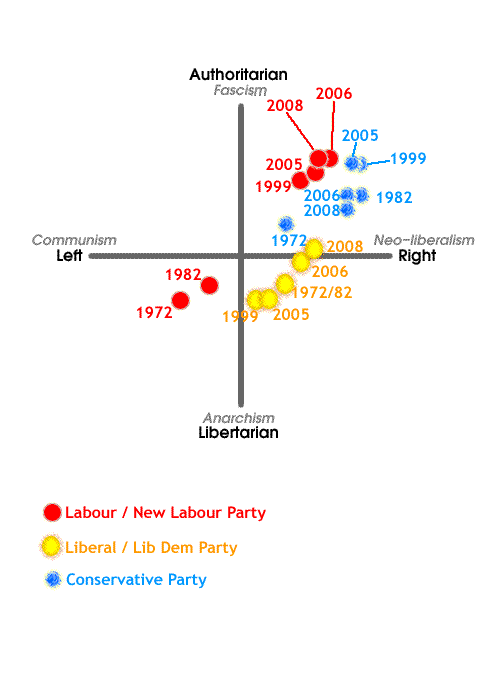
"Right wing" and "left wing" are relative concepts, determined based on where on the left-right spectrum the current political consensus lies. In England, the influence of UKIP (among other factors) has and continues to drag politics ever further to the right, to the extent that we now have a situation where, in many respects, the Conservative Party of the 70s, if it existed today, would be to the left of the current Labour Party. (From a US perspective, where many conservatives hilariously refer to the right-leaning Barack Obama as "socialist", the entire UK political system probably still looks pretty left-wing.)
In Scotland, despite all the claims of the Better Together/Project Fear mob to the contrary, the political climate is substantially different, and the Lib/Lab/Con hegemony that defines Westminster politics doesn't exist. The Tories, while not wholly extinct (yet), are now little more than a protest vote north of border, and the two main parties, between whom every election is primarily contested, are not the Tories and Labour but rather Labour and the SNP. The SNP, despite having attracted the nickname "Tartan Tories" in decades gone by, have long since outflanked Labour on the left, campaigning on a platform that is pro-immigration, social justice, Welfare State and unilateral nuclear disarmament. Scottish Labour, whose policies are designed in their entirety by the broader British Labour Party, find themselves in the unenviable position of having to sell policies decided to appease UKIP supporters to an electorate that is largely social democratic in its principles, if not full-on socialist. This, no doubt, is why so much of what comes out of SLab representatives' mouths is so hopelessly muddled and the calamitous Johann Lamont (SLab's "leader" -- though she has no real power) routinely contradicts herself and has to deny ever saying things that are a matter of record. (Her call to end free universal benefits and her "something for nothing country" comment, which she denies ever having made despite it being available on YouTube for all to see, are a case in point.)
The result of this is that Labour is in terminal decline in Scotland. They may not have suffered a Tory-style wipe-out yet, but I'm convinced that they're well on the road to it. The writing was on the wall in the aftermath of the 2011 Holyrood election, where the SNP won an outright majority in an electoral system that was supposed to prevent such an outcome ever happening, taking seats in areas that had been held by Labour (in Westminster and local elections) for nigh on a century. The "I vote Labour 'cos my da voted Labour" contingent is still substantial, but the party's grip on the electorate is weakening, due to a combination of anger at Blair's lies, the Iraq war and widespread corruption in local politics, and the fact that there's little point in voting for a party whose greatest aspiration is to be minutely less brutal than the Tories when there exists a credible centre-left alternative in the form of the SNP (and smaller parties like the Greens and Scottish Socialists, who have a far better chance of being elected in Holyrood which uses the D'Hondt system of proportional representation than in Westminster with its archaic and profoundly anti-democratic First Past the Post).
If the Tories, Lib Dems and Labour represent the right, centre and left of Westminster politics, then I would argue that the right, centre and left of Scottish politics are effectively represented by Labour, the SNP and Scottish Green Party respectively. (Let's ignore for a moment the fact that the Lib Dems and Tories still have more seats at Holyrood than the Greens -- by demonstrating a willingness to work constructively with the government rather than opposing it for opposition's sake, the Greens have managed to make themselves a far more significant force in Scottish politics. The Equal Marriage Bill, for instance, was carried through parliament by the Greens' Patrick Harvie.)
So Labour are on the left of UK politics but on the right of Scottish politics. (I'm not going to get into Wales and Northern Ireland because I don't know enough about their respective political climates to comment on them.) And yet the dismal Ed Miliband continues to campaign under the spurious "One Nation Labour" banner... nicked, incidentally, from former Tory Prime Minister Benjamin Disraeli. If that slogan is not the perfect illustration that Labour have become the Tories (while the SNP has become Labour, and the Tories have become UKIP, and UKIP have become... well, they've always been a far more dangerous version of the Monster Raving Loony Party, I guess), then I don't know what is.
I'll explain...
"Right wing" and "left wing" are relative concepts, determined based on where on the left-right spectrum the current political consensus lies. In England, the influence of UKIP (among other factors) has and continues to drag politics ever further to the right, to the extent that we now have a situation where, in many respects, the Conservative Party of the 70s, if it existed today, would be to the left of the current Labour Party. (From a US perspective, where many conservatives hilariously refer to the right-leaning Barack Obama as "socialist", the entire UK political system probably still looks pretty left-wing.)
How the parties have shifted since the 70s (courtesy of Political Compass)
In Scotland, despite all the claims of the Better Together/Project Fear mob to the contrary, the political climate is substantially different, and the Lib/Lab/Con hegemony that defines Westminster politics doesn't exist. The Tories, while not wholly extinct (yet), are now little more than a protest vote north of border, and the two main parties, between whom every election is primarily contested, are not the Tories and Labour but rather Labour and the SNP. The SNP, despite having attracted the nickname "Tartan Tories" in decades gone by, have long since outflanked Labour on the left, campaigning on a platform that is pro-immigration, social justice, Welfare State and unilateral nuclear disarmament. Scottish Labour, whose policies are designed in their entirety by the broader British Labour Party, find themselves in the unenviable position of having to sell policies decided to appease UKIP supporters to an electorate that is largely social democratic in its principles, if not full-on socialist. This, no doubt, is why so much of what comes out of SLab representatives' mouths is so hopelessly muddled and the calamitous Johann Lamont (SLab's "leader" -- though she has no real power) routinely contradicts herself and has to deny ever saying things that are a matter of record. (Her call to end free universal benefits and her "something for nothing country" comment, which she denies ever having made despite it being available on YouTube for all to see, are a case in point.)
The result of this is that Labour is in terminal decline in Scotland. They may not have suffered a Tory-style wipe-out yet, but I'm convinced that they're well on the road to it. The writing was on the wall in the aftermath of the 2011 Holyrood election, where the SNP won an outright majority in an electoral system that was supposed to prevent such an outcome ever happening, taking seats in areas that had been held by Labour (in Westminster and local elections) for nigh on a century. The "I vote Labour 'cos my da voted Labour" contingent is still substantial, but the party's grip on the electorate is weakening, due to a combination of anger at Blair's lies, the Iraq war and widespread corruption in local politics, and the fact that there's little point in voting for a party whose greatest aspiration is to be minutely less brutal than the Tories when there exists a credible centre-left alternative in the form of the SNP (and smaller parties like the Greens and Scottish Socialists, who have a far better chance of being elected in Holyrood which uses the D'Hondt system of proportional representation than in Westminster with its archaic and profoundly anti-democratic First Past the Post).
If the Tories, Lib Dems and Labour represent the right, centre and left of Westminster politics, then I would argue that the right, centre and left of Scottish politics are effectively represented by Labour, the SNP and Scottish Green Party respectively. (Let's ignore for a moment the fact that the Lib Dems and Tories still have more seats at Holyrood than the Greens -- by demonstrating a willingness to work constructively with the government rather than opposing it for opposition's sake, the Greens have managed to make themselves a far more significant force in Scottish politics. The Equal Marriage Bill, for instance, was carried through parliament by the Greens' Patrick Harvie.)
So Labour are on the left of UK politics but on the right of Scottish politics. (I'm not going to get into Wales and Northern Ireland because I don't know enough about their respective political climates to comment on them.) And yet the dismal Ed Miliband continues to campaign under the spurious "One Nation Labour" banner... nicked, incidentally, from former Tory Prime Minister Benjamin Disraeli. If that slogan is not the perfect illustration that Labour have become the Tories (while the SNP has become Labour, and the Tories have become UKIP, and UKIP have become... well, they've always been a far more dangerous version of the Monster Raving Loony Party, I guess), then I don't know what is.
Labels:
barack obama,
benjamin disraeli,
conservatives,
ed miliband,
greens,
holyrood,
johann lamont,
labour,
patrick harvie,
politics,
project fear,
scotland,
snp,
ssp,
tony blair,
ukip,
westminster
Subscribe to:
Posts (Atom)