Sunday, 28 September 2014

A bumper box of spooktacular fun


With Halloween just over a month away, I decided to treat myself and picked up Anchor Bay's recently released 15-disc deluxe HALLOWEEN: THE COMPLETE COLLECTION Blu-ray box set, containing the eight original HALLOWEEN films and the two Rob Zombie remakes. Having only ever seen the first film, HALLOWEEN H20 and the first Zombie film, this is a bit of a gamble for me, and I'm aware that, as is invariably the case with long-running series, most people are of the opinion that the law of diminishing returns kicks in pretty quickly.

That said, the HALLOWEEN series is more or less required viewing for any horror fan, and it's always been a source of mild embarrassment to me that it's taken me so long to correct this oversight. Besides, this set includes the holy grail that is the producer's cut of HALLOWEEN: THE CURSE OF MICHAEL MYERS, in addition to correcting the botch job that was done on mono audio track of the standalone release of the first film. (I sat down to watch it back in July and it would be no exaggeration at all to say that the balance between dialogue, FX and music was so bad as to render it unwatchable. I ended up watching it with the 7.1 remix selected instead.)

I'm not sure whether I'll have the time or inclination to do a write-up for each film in the series, but I'd quite like to write up my overall thoughts in the series once I've had the chance to see it from beginning to end.

Wish me luck!

Thursday, 25 September 2014

Try not to laugh when you read this

This was posted by someone in one of the Facebook groups of which I'm a member. Published by the Daily Express in 1991, it predicts what life will be like in 2010. It would be funny if the reality wasn't so tragically different.

Monday, 22 September 2014

You are the company you keep

The independence referendum was a bit of an eye-opener for me in that it revealed not only the depths to which the establishment was prepared to sink in order to hang on to vested interests, but also the willingness of supposedly sworn enemies to reveal that, in reality, you couldn't put a cigarette paper between them. Not only were Labour happy to stand shoulder to shoulder with the Tories -- they were also more than happy to cooperate with even less salubrious individuals.

For instance, here's Labour MP for Aberdeen South Anne Begg posing in a cosy clinch with the delightful Dave MacDonald, leader of the Scottish National Front:


And here's ginger rodent Danny Alexander, Liberal Democrat MP for Inverness, Nairn, Badenoch & Strathspey, campaigning side by side with Scotland's sole UKIP MEP, the charming David Coburn:


Lends a whole new meaning to the words "Better Together", doesn't it?

(Images source: Wings Over Scotland)

Sunday, 21 September 2014

And on a happier note...

On Friday night, Glasgow's city centre was blighted by the ugliest scenes of violence and hatred I've seen in the city in my lifetime. The following day, in the same location where less than 24 hours ago knuckle-dragging Neanderthals draped in Union Jacks had performed Nazi salutes and assaulted innocent bystanders, this appeared:


These are donations for the city's many food banks. My faith in humanity is some way towards being restored.

Saturday, 20 September 2014

A tale of two cities

Glasgow a week ago...


And last night...


These two videos sum up the difference in the mood of this city before and after the independence referendum. Thousands of peaceful Yes supporters occupied George Square for days in the run up to the vote, without a single incident. Late on the afternoon of the 19th, following the No vote, knuckle-dragging louts associated with the Orange Order and the BNP descended on George Square. They attacked the small number of remaining Yes supporters, screamed abuse at them, burned flags and performed Nazi salutes under the shadow of the memorial to the World War 2 dead. Riot police arrived and managed to contain them, but a number dispersed throughout the city centre, leading to scenes like the one in the video above on Buchanan Street.


Out today on Dumbarton Road, the main road running through Partick, the mood was palpably grim. Whether people were Yes or No voters, I could see little evidence of anyone being happy with the outcome. With the first of the three Westminster leaders' promises (a timetable for further devolution published before parliament the day after a No vote) reneged on already, I suspect that a great many who voted to remain in the union are already waking up to the fact that they voted for a pack of lies.

Friday, 19 September 2014

Fuck.


Right now, I reckon I feel just about as low as it's possible to feel, short of suffering a bereavement. Last night, we had a once in a lifetime chance to make a fresh start, and we threw it away.

Well, 45% of us took that chance. The other 55% decided, for a variety of reasons that are their own, to endorse the status quo. The majority, I'm sure, did so because they genuinely believed it to be the best thing for the country, and I really, REALLY hope they're right. But I can't shake the feeling that in doing so, they implicitly voted for a future that consists of more austerity, food banks, privatisation of the Welfare State, the House of Lords, an undemocratic electoral system, and billions spent on immoral nuclear weapons in the Clyde while one in five children grows up living below the poverty time. The polls suggest that the young and the poor voted Yes, while the rich and the elderly voted No. This was always essentially a class and a generational struggle, and the working class and the young, as is so often the case, got kicked in the teeth last night.

About a year ago, I told myself that in future, if anyone who voted No complained about anything that came our way via the Westminster government, I would quietly remind them that they endorsed it with their vote. I'm not going to do that. It's petty and stupid and helps no-one. People voted No for a variety of reasons, but there's little doubt in my mind that many of the crucial 5% that could have taken us over the finish line did so out of fear. For two and a half years, but especially in the last fortnight, we have been bombarded with a barrage of scare stories dreamed up by the self-titled Project Fear campaign and dutifully reported, without any interrogation, by the supine media. No threat was too great. The elderly were told they would lose their pensions, immigrants were told they would be deported, the terminally ill were told they would be denied life-saving operations... Unable to construct a positive case for the union, they instead settled on bullying the most vulnerable into voting No out of fear.

45% of the electorate won't forget that. In circling the wagons to protect the interests of the establishment, I believe the Labour Party, the BBC and indeed mainstream media as a whole have completely shredded their trust with a significant portion of the population. Many will never vote for them or buy their products again, making this a pyrrhic victory for them. Already, the last minute promises of new powers are unravelling, as backbench Tories declare their intent to vote down any transfer of powers to Holyrood, and already the language has shifted away from "DevoMax" to "extensions of existing powers". Such is life. Tories will be Tories. But I reserve my greatest contempt for the Labour Party, who I suspect will bear the brunt of Yes voters' anger for years to come. The sight of them cheering and dancing with their supposed adversaries the Tories made me sick to my stomach, and I suspect that is an image that will long remain in the minds of their former supporters. The fact that their traditional heartlands -- Glasgow, Dundee, North Lanarkshire, West Dunbartonshire -- voted Yes suggests that they are in for a well-deserved annihilation.

In the end, we fought the good fight, but it wasn't enough. We took on the combined might of the media, the banks, big business, Westminster and a seemingly endless stream of sycophantic "celebrities". We put up a good fight, but we lost. What comes next, I've no idea. I suspect we're going to have a fight on our hands just to get the baubles we were belatedly promised. But I also suspect that, when the dust settles and people realise they've been duped, demand for a second referendum will grow louder and louder. Alex Salmond, who has more magnanimity than I'm capable of possessing at the moment, says that the matter is settled for a generation. With respect, he may find that that is not his decision to make.

As the saying goes, fool me once, shame on you. Fool me twice, shame on me. In 1979, we were narrowly cheated out of getting our own parliament. In 1997, we voted for it by an overwhelming majority. History has a habit of repeating itself. 1.6 million people last night voted Yes. That is not, by any stretch of the imagination, a decisive vote of confidence in favour of the Union. And the young, angry and newly enfranchised electorate that voted for independence last night will still be around long after the over-60s who voted for the status quo are no longer with us.

Sunday, 14 September 2014

The final stretch

My nerves are in tatters. I'm having difficulty sleeping, and even more difficulty concentrating on anything other than constantly refreshing my Facebook and Twitter feeds. I'm lurching between extreme feelings of optimism and pessimism several times a day.

Why? Because we're entering into the final stretch of the campaign for Scottish independence. Four days and it'll all be over. By any stretch of the imagination, it's been a long campaign, and yet I still can't believe we're nearly there.

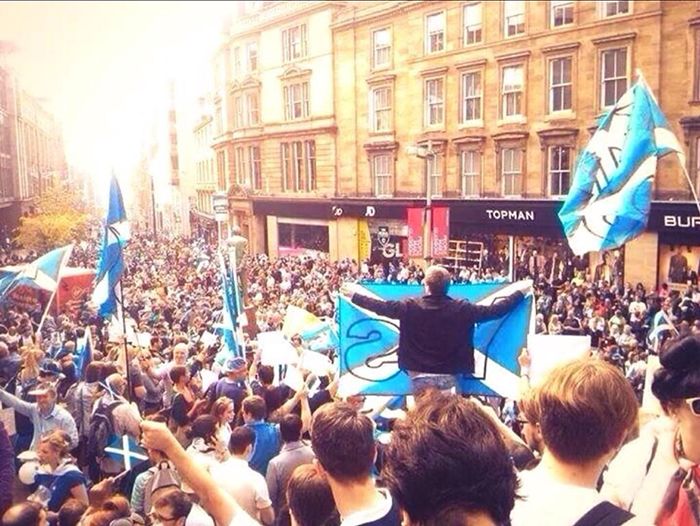
And I still have no idea how it's going to go. The polls are all converging in the middle, with one or two outliers on either side, but all agree that there's more or less a 50/50 split between Yes and no. A poll released yesterday by Survation put Yes on 47% and No on 53%. Mere hours later, however, the situation was reversed by an ICM poll putting Yes on 54% and No on 46%. The feeling on the ground for me is that Yes is ahead, but to a large extent I suspect that's down to the fact that most of my friends are in their late twenties to early thirties -- by some margin the most Yes-friendly demographic. Every day I'm seeing amazing, awe-inspiring sights, either in person or online -- Buchanan Street brought to a standstill yesterday by Yes supporters, or an estimated 4,000 (as per Sky News) marching past my workplace during my lunch break today, on their way to Pacific Quay to protest against the BBC's shameful anti-independence propaganda. The past week has seen the most shocking concerted blitzkreig against the Yes campaign, orchestrated by Downing Street with the complicity of the banks, big business and the mainstream media, and yet the smiling, happy faces wearing their Yes badges and waving their saltires seem undaunted. And the polls have continued to narrow. Scotland doesn't feel to me like a nation that's about to vote against its own self-determination.

And yet there are still so many people who remain steadfastly opposed to a Yes vote, even if many of them do genuinely like the idea of independence. Where I and others like me see opportunity, they see only risk. Where we see an end to nuclear weapons, illegal wars, food banks and privatisation of the NHS, they fret about currency, capital flight and their pensions (which ironically are at far greater risk if we vote No). I understand their fear, and I don't hold it against them. By and large, these people have, in my estimation, been brow-beaten by a two-and-a-half-year barrage of negativity and scaremongering into believing that it's all too risky and that Scotland, uniquely out of all the countries in the world, is too feckless to look after its own affairs. I find that unbelievably sad and, though I know I'm going to sound like one of these "true believers", I'm going to say it: I wish I had some way of showing these people what I've seen. And I hope, if we vote Yes on Thursday, that they'll eventually see it too.

An unprecedented 97% of the adult population is registered to vote. Some are predicting a turnout approaching 90%. Whatever happens on Thursday, we have brought democracy out of retirement. The general population is engaged in the democratic process like never before. People of all backgrounds, ages, genders and ethnicities are earnestly talking politics in a way that would have been unthinkable a couple of years ago and is, I suspect, still unthinkable throughout the rest of the UK. And the other side hate it. You can see it in the contorted faces of Alastair Darling, Gordon Brown, Johann Lamont, George Galloway and all the various LibLabCon clingers-on. They absolutely LOATHE this process. On Thursday 18th September, the people hold the power, and it scares the shit out of them.

This will most likely be my last significant post on the subject before Thursday, so I'll say nothing more for the time being other than "See you on the other side", and, come Friday, if I disappear off the face of the earth for a couple of days, you'll know it's because I'm either celebrating or drowning my sorrows in Pepsi Max.

To quote Irvine Welsh, good luck, Scotland, "you gorgeous handsome sexy democratic bastard, you."

Monday, 8 September 2014

The flood continues


http://scotgoespop.blogspot.co.uk/2014/09/yes-draw-level-in-electrifying-poll.html

Something incredible seems to be happening. Over the last couple of weeks, two of the most No-friendly pollsters, YouGov and TNS-BMRB, have recorded support for a Yes vote on the 18th increasingly exponentially. The YouGov poll that hit the interweb on Saturday night put it two points ahead of No, while the results of the TNS poll that emerged tonight add weight to the trend observed by YouGov, showing the two sides level-pegging.

I really didn't think anything like this would happen. I was more or less resigned to the notion of Yes remaining the underdog as we went to the polls and banking on a large number of non-voters beyond the reach of such surveys turning out to swing things in our favour. And if you'd told me a week ago that YouGov and TNS would be the first two pollsters to show Yes level pegging, let alone in the lead, I'd have laughed at you and called you delusional.

I mentioned recently, either on Facebook or on this very blog, that because this referendum has no precedent, the various pollsters are more or less casting around in the dark in their attempts to get their weighting criteria right, hence why the numbers from the different firms have been all over the shop. I still stand by that assertion, which is why I'm not going to assume these two polls are accurate simply because they show my side in a favourable position. What the polls do do, however, is allow us to observe broad trends over time, and YouGov and TNS both appear to be telling us that there has been a massive swing to Yes in an incredibly short space of time. If you believe YouGov, No has gone from enjoying a 22-point lead to a 2-point deficit in the space of a month. That is literally extraordinary, but shows an echo of the 2011 Scottish Parliament election, which saw the SNP turn a 20-point deficit into a 15-point lead in the final weeks.

I'm not going to break out the champagne and declare premature victory. These polls are the living proof that a week is a long time in the world of politics, and for all we know both firms could be drastically overestimating the support for Yes. And there is no doubt in my mind that the UK government, aided by a supine media, will throw everything they've got at us in an attempt to defeat what, to them, is the single greatest constitutional crisis in the union's history. But this is certainly the most confident I've ever felt that we're on our way to victory.

On a side note, I'm absolutely loving the fact that the Westminster Village and adoring media hangers-on have finally woken up to the fact that yes, there is a referendum taking place in Scotland, and yes, it could mean the end of the United Kingdom. Things have certainly got a whole lot more entertaining since these gormless twits started pontificating about it in the newspapers and on TV. The other night, for instance, I came across a couple of ladies on the BBC News channel doing a "review" of the papers and struggling to comprehend the headlines they were seeing about Yes pulling ahead in the polls. One made tired jokes about rebuilding Hadrian's Wall (which is some 68 miles south of the border between Scotland and England) and lamented the fact that she had Scottish blood in her family tree somewhere and that it was most unfair that she didn't get to vote, while the other wailed "I just don't think they've thought this through!" Yes, because you, who've only belatedly realised that this debate is actually taking place, naturally understand it far better than those of us who've been engaging with it for the last three years.

Dolts.

And, to end on a somewhat tongue-in-cheek note...


I'm not going to lie -- it was my first thought this morning when I read the "news" that unemployed mum-on-benefits Kate Middleton is up the duff again. While I wouldn't go so far as to suggest that she was impregnated by royal decree in a bid to save the union (because nothing unites the four nations like a royal brat, or some such nonsense), the cynic in me does wonder at the timing of the announcement.

There's no doubt in my mind, incidentally, that if we win our independence on the 18th, the next major constitutional cause I'll be throwing my backing behind will be the abolition of the monarchy. An independent, social democratic Scottish republic has kind of a nice ring to it.

Saturday, 6 September 2014

Here comes the flood


But don't worry, defenders of the union, the great statesman and paragon of internationalist socialism that is Ed Miliband has devised a cunning ruse to hold back the turning of the tide:

Friday, 5 September 2014

When the gloves stay on...


Keira Knightley smouldering in a recent photoshoot for Interview Magazine.

Wednesday, 3 September 2014

People power


A truly awe-inspiring sight: people queuing yesterday in Glasgow to get registered to vote in the referendum ahead of the midnight deadline. At no point in history has the country seen this much engagement with the political process or has so high a turnout been predicted. Regardless of where you stand on the debate, this is a wonderful thing for democracy... right?

(Note: this is not my photo, but I've seen it posted in various places and can't ascertain the source.)

Tuesday, 26 August 2014

It's a knockout!


I approached last night's debate between Alex Salmond and Alistair Darling with some trepidation. While I thought the previous debate, on STV at the beginning of the month, was nothing like as bad for the First Minister as the media were desperate to claim, I won't deny that it was a low key and somewhat lacklustre performance for a man renowned for his barnstorming style. I also strongly disliked the adversarial format STV adopted which, in conjunction with the frequent ad breaks, rendered the debate disjointed and at times infuriatingly shouty as both men talked over each other in an attempt to make their points. Mindful that largely the same format would be used for the second of the two debates, and of the BBC's less than stellar (to put it mildly) coverage of the referendum to date, I very nearly didn't watch it live.

But at the last minute I changed my mind, and boy, was I glad I did. Taking place in Glasgow's Kelvingrove Art Gallery, the lavish surroundings immediately gave the proceedings a classier feel than the generic studio set STV used at the Conservatoire with its garish primary colours and Jeremy Kyle-style stage and audience gallery. Right from the bat, Salmond seemed to be on form, clearly articulating his vision for an independent Scotland while all Darling could do was angrily jab his finger at "him" and once again fall back on the question of currency. It was the main line of attack he adopted in the previous debate and the subject on which the First Minister came most unstuck last time round. Clearly thinking he was on to a winner, Darling chose to retread the same ground again and again -- something which the audience had audibly grown tired of by the third time he brought it up, as evinced by the chorus of groans that rang out in the gallery.

Faced with clear, concise rebuttals from Salmond and a "Well, what would you do, then?" line of questioning from moderator Glenn Campbell, Darling came unstuck in dramatic fashion. "Of course we could use the pound!" he spluttered in exasperation, and with that the last remaining Project Fear scare story came crashing down. From then on, it was downhill all the way for the former Chancellor, with Salmond seeming to grow in stature by the minute and the audience turning against his opponent in a manner that seemed to suggest a genuine sea change of opinion, at least among those present. Indeed, the biggest body blows for Darling actually came from the impressively clued-up audience, in particular one woman who called him out on his rank hypocrisy regarding his own association with private healthcare providers and told him she hoped he could "feel Aneurin Bevan sitting on [his] shoulder":


As with the previous debate, the most frustrating section by far was the part where the two men cross-examined each other, owing mainly to Campbell's virtually non-existent moderation and Darling's insistence on asking Salmond a question, only to interrupt him three seconds into his answer. To a certain extent, Salmond gave as good as he got, leading to an at times incomprehensible babble of noise, but as his deputy Nicola Sturgeon learned when up against Johann Lamont, when your opponent is shouting you down and talking over you, you really have no option but to raise your own voice to make yourself heard. It wasn't a particularly edifying spectacle in either case, but as with the infamous Sturgeon/Lamont "stairheid rammy", there's little doubt in my mind as to who was at fault.

The cross-examination wasn't a complete dead loss, however. In the STV debate, Darling's biggest Achilles' heel was his inability to name any new powers that would be devolved to Scotland following a No vote, and I genuinely thought he would have come in better prepared this time round. Imagine my surprise, then, as, when asked by Salmond to name three new job-creating powers that would be devolved post-No, Darling again blinked and spluttered before coming out with some feeble line about the UK already providing a wealth of jobs and opportunities. Left defending savage Tory cuts and the hounding of the poor and disabled, he could only feebly insist "Look, I'm a Labour politician" -- a distinction which, most will agree, has long since ceased to be anything more than purely academic.

Since the very beginning, the Yes campaign have been at pains to point out that this referendum is not a vote on Alex Salmond, or Alastair Darling, or for that matter anyone else, but rather about whether the people of Scotland have a right to determine their own destiny, and Salmond made that point again last night. That said, I wouldn't want to underplay the potential for such a strong performance from Salmond to galvanise the broader Yes campaign. Even if last night's debate didn't directly change a single mind, it still provides the "ground soldiers" who are manning stalls, knocking doors and signing up unregistered voters every day with a renewed sense of optimism and purpose as we head into the crucial final three weeks of campaigning.

It's often said that you're only as good as your last performance. As such, if Salmond genuinely did (as I suspect) choose to keep his powder dry and concentrate all his energy on the second of the two debates, then it was certainly the right one to focus on. And with the first postal votes landing on people's doormats (mine included) within the next 36 hours, Salmond the bruiser came to the fore not a moment too soon.

In honour of Synapse Films' upcoming Blu-ray release of Suspiria...


...here's the film's co-star, Italian actress Stefania Casini.

Sunday, 24 August 2014

Nice one, Eck


I have it on good authority that David Cameron has refused to accept his challenge, but will still donate a sum to the charity.

Tuesday, 19 August 2014

The poll you may have missed

With just under a month to go until Scotland votes on whether to remain in the UK or go independent, I'm becoming more and more preoccupied by the outcome. We repeatedly find commentators on TV and in the papers insisting that it's a done deal, that the Yes campaign will be defeated and that pesky Alex Salmond will be sent packing once and for all -- an assertion that they repeat so often and with such insistence that you can tell they desperately hope it's true. Myself, I don't claim to know what the outcome will be. I desperately hope that it's a Yes vote, and the the general impression I get from my colleagues and my own peer group is that that's the way things are headed, but subjective impressions can be very dangerous. My dad, in contrast, is comfortably off and in his 60s, and virtually everyone he knows is a virulent No voter. (He's the sole Yes voice in his wine circle -- and his surprise and disappointment at being the only Yes voter in a wine circle always strikes me as vaguely amusing. It's like coming home from a trade union meeting and expressing surprise that it was dominated by left-wing voices.) Which is unsurprising, because rich, old people are the most No-friendly demographic (the rich because they don't see the need for change, the old because people over the age of 60 traditionally have a much stronger British identity and still remember a time when the standard of living within the union was improving rather than declining).

The point is that you can't just go by your own personal experiences and assume that they hold true for the entire country...

...which is why what the Radical Independence Campaign has been doing is so fascinating. They've been out knocking on doors in the most deprived parts of Scotland, canvassing people on their voting intentions. The results, which never get a lick of airtime in the mainstream media, should be enough to make even the most courageous unionist soil his Union Jack Y-fronts:


Mass canvass figures released 19th August 2014.

It should come as no surprise that support for the union is lowest among those who have the least to lose. These are communities that have been let down by successive Tory and Labour governments, and who in normal elections turn out to vote in depressingly low numbers, because they feel completely disconnected from the political process and believe their vote will make little difference. Except this isn't a normal election -- it's a referendum on the very future of the country, and while the Yes and No camps rarely agree on anything, one thing that both acknowledge is that turnout on the 18th of September is likely to be at unprecedented levels.

This is why I don't put much faith in the "official" polls carried out by the likes of YouGov and Ipsos MORI, all of which have consistently showed a No lead (some fairly strong, others wafer thin). While analysing them can be interesting, and James Kelly over at SCOT Goes POP! does an outstanding job of doing just that, they're all based on guesswork to an extent, with the various pollsters devising complex and often arcane weighting procedures in an attempt to get an accurate result.* Most of these, as far as I can tell, consist of looking at the way people have voted in previous elections and performing various calculations to upweight or downweight respondents accordingly (in addition to other factors like country of birth, social bracket, gender and age). That's all well and good, but what do you do when you have somewhere in the region of a million people who have never voted before but are now expressing a desire to cast their vote on the 18th?

(* What I think these polls DO allow us to do is to identify broad trends. For example, three of the six main pollsters have released polls since Sunday, and all of them show a swing to Yes of between 2 and 4% compared to their previous respective polls. That suggests that some movement from No to Yes has indeed taken place since Alex Salmond and Alastair Darling went head to head on STV. What it doesn't tell us is whether the figures they started out with before the shift took place were remotely accurate.)

As I've said before, I've no idea how the vote is going to go, but if the so-called "missing million" turn out in their droves on polling day, then things could get very interesting.

And for those in the rest of the UK unsure about or opposed to Scottish independence, here's something for you to ponder: a Yes vote will almost certainly lead to the unilateral nuclear disarmament of the UK and could well lead to David Cameron being forced out of office, if not the fall of the entire government. If it was me, I'd be saying:

Saturday, 16 August 2014

Lindsey time

I discovered Arizonan musician Lindsey Stirling completely by accident while surfing YouTube one day. Described on her web site as a "dancing dubstep violinist", she combines a traditional Celtic folk sound with dance and electronica, leaping and prancing around the stage like a crazy ballerina. She's quite something to behold:


Oh, and she was told she'd never amount to anything by Piers Morgan, which automatically makes me predisposed to liking her.


Tuesday, 12 August 2014

Film review: Opera

There is broad agreement on the notion that OPERA constitutes the end of Dario Argento's decade-long golden age. While he would subsequently go on to make a number of good and even great films -- 1996's THE STENDHAL SYNDROME being the standout -- this 1987 giallo is clearly the end of an era in many regards. It was the final time he would work with a number of his key collaborators and the last time his camerawork truly featured the vibrant, sweeping, Grand Guignol qualities for which he is justly celebrated. It would be six years before Argento directed another feature length project, and it's tempting to lay at least some of the blame for his subsequent decline on that self-imposed hiatus, bowing out at the height of his creativity.


With its sordid sexuality, allusions to the AIDS virus (it's no accident that the killer wears latex "protection" over his traditional black leather gloves) and a distinctly cruel streak running through its proceedings, OPERA feels very much like the giallo, which grew out of the sociocultural climate of the early 70s, responding to the mood and anxieties of the 80s, and provides a tantalising glimpse at where the movement might have gone had it continued to flourish. Even the camerawork, courtesy of the Oscar-winning English cinematographer Ronnie Taylor, feels aggressive, constantly moving, alternating between sweeping overhead shots and claustrophobic close-ups of the actors' faces. The latter are used to particularly powerful effect in the numerous shots of the protagonist, opera ingenue Betty, with rows of needles taped under her eyes to prevent her from closing them -- surely one of the most uncomfortable and arresting visual images Argento has ever created.


Like much of Argento's output, it's not really an actors' film, but the best performance by far is courtesy of Scottish stage actor Ian Charleson who, a few short years before his untimely death, delivers a nuanced and oddly sympathetic portrayal of a horror movie director helming an experimental production of MACBETH -- a thinly veiled stand-in for Argento himself. As Betty, Cristina Marsillach is a good deal more drippy than both previous and subsequent Argento female leads, serving as far more of a damsel in distress than the likes of Jessica Harper in SUSPIRIA or Jennifer Connelly in PHENOMENA, but she does what the role asks of her and acquits herself perfectly adequately. As far as the stable of Argento regulars is concerned, this is the last appearance of Daria Nicolodi (prior to MOTHER OF TEARS in 2007) and the first of three appearances by the wonderfully over-the-top Coralina Cataldi-Tassoni, who a year earlier made her debut in the Argento-produced DEMONS 2.


Its flaws -- awkward dialogue, the ill-placed use of heavy metal and a plot that doesn't stand up to scrutiny -- are par for the course with Argento's output during this period, but are part and parcel of what gives these films such a distinct identity. Indeed, the sheer audacity of its set-pieces -- of which the infamous "bullet through the peephole" is but one of many -- thoroughly overshadows any narrative shortcomings. It may not hit the dizzy heights of SUSPIRIA, DEEP RED or THE BIRD WITH THE CRYSTAL PLUMAGE, each of which constituted a perfect alchemy in which every single element worked in tandem to deliver a film that was more than the sum of its parts, but OPERA remains one of the greats and serves as a fitting swansong to the most productive and creatively satisfying period in its director's career.

Wednesday, 6 August 2014

Big Eck vs. Flipper


So, the big Alex Salmond/Alistair Darling debate. How was it for you? If my experience is anything to go by, I’m willing to bet “frustrating” is the answer.

Frustrating because I heard nothing from either politician that I hadn’t heard before. Frustrating because I felt Darling, true to form, treated the electorate with barely disguised contempt. Frustrating because I felt Salmond missed several opportunities to really skewer Darling and allowed himself to be forced into a corner on the issue that will always be the Yes campaign’s Achilles’ heel -- currency.

I genuinely don’t understand Salmond’s strategy on this matter. Actually, that’s not entirely accurate -- I understand the strategy, but I don’t understand the way he chooses to articulate it. I get that a currency union is the SNP’s preferred option and the one they intend to take to the negotiating table. But really, why is it so difficult for him to articulate an alternative? Why, in the face of Darling’s belligerent repetition of the same question and the growing impatience of the audience, could he not simply have responded “Our Plan A is a currency union, but if the UK Government -- flying in the face of all logic and self-interest, chooses to cut off its own nose to spite its face -- here’s what we will do.” Darling’s jibes about rupees and Panama may have been puerile, but could easily have been swatted aside by pointing to the range of countries that have, at various points in history, adopted another currency without a formal union -- many of them using the pound. Isle of Man, anyone? Because there are, after all, a range of options -- most of which would involve Scotland walking away from all the UK’s national debt.

The silver lining in this cloud is that evidence suggests that few people in Scotland rate which currency we’ll use as their number one priority. (2%, according to a TNS-BMRB poll.) Rather, in focusing so obsessively on this one issue, we’re following the media/Better Together agenda. Politicians and media pundits are interested in these matters -- the average person on the street is more interested in things that affect them directly, like the NHS, jobs and how much money they have in their pocket. These can’t be COMPLETELY decoupled from the question of whether we’ll be using the pound in a currency union, or the pound informally, or a Scottish pound pegged to the UK pound or whatever, but issues like the Bedroom Tax, food banks, the obscenity that is Trident and the carving up of the NHS south of the border resonate far more directly with voters than the issue Darling spent his entire Q&A session withering on about.

While he certainly landed some body blows in terms of issues like London’s plundering and squandering of North Sea oil and the threat of Eurosceptic England dragging Scotland out of the EU against its will, I was rather bemused to see Salmond spending so much time asking Darling about the bizarre comments many of his Better Together teammates have made about the consequences of independence. These include an increased risk of attacks from outer space (Philip Hammond), having to drive on the right (Andy Burnham) and the forced removal of the pandas from Edinburgh Zoo (I forget who came up with that one). The purpose of this line of questioning, presumably, was to make Better Together appear ridiculous and to diminish their credibility. The only problem was, a lot of people would have been hearing these fantasies for the first time last night, coming out of Alex Salmond’s mouth, thereby running the risk of making HIM rather than Better Together appear ridiculous. Still, Darling’s response was laughable. Oh, he scoffed, those were just jokes. What other threats were jokes, then, I wonder? Ian Davidson’s notorious “bayonet the wounded” comments? Peter Fraser’s “England would have no choice but to bomb Scottish airports”? Theresa May withering on about border posts?

Or perhaps the refusal to enter into a currency union? Was that, too, just a joke? You see, when you keep saying silly things, people begin to wonder if EVERYTHING that comes out of your mouth is equally stupid.

What I thought was utterly shocking, and very revealing, was Darling’s point blank refusal to admit that an independent Scotland could be successful -- a point conceded on various occasions by many of his Better Together colleagues. How hard would it have been for him to say “Yes, it’s possible, but I believe we’d be even more successful in the UK”? But he couldn’t bring himself to do it, even with both Salmond and adjudicator Bernard Ponsonby repeatedly pressing him and the audience jeering at him. That speaks volumes about how Darling and those like him really view Scotland.

Of course, the elephant in the room throughout all of this is that the man who should have been debating Salmond, David Cameron, was nowhere to be seen. In failing to step up to the plate to defend the union he believes in so passionately, Cameron actually makes the case for independence more succinctly than anyone on the Yes side: our current political arrangement has delivered a Prime Minister so loathed by one part of the UK that he daren’t show his face lest his unpopularity contribute to bringing the union to an end. Darling, as a backbench opposition MP who holds no actual power, has no authority to promise anything one way or the other. There’s no point asking him about Scotland’s future within the UK because he has no influence on it. He can demand clarity and certainty from Salmond all he likes, but the reality is that we got the monkey rather than the organ grinder last night.

One of the biggest frustrations, for me, was hearing the same old arguments being trotted out by both sides. Over the last couple of years, I’ve been heavily engaged with the independence debate, reading all manner of articles and comments online, watching videos of debates and speeches given by both sides (though admittedly heavily weighted towards the Yes side, given that they’re the only ones who actually engage with the public on a regular basis). The ambition and breadth of original thinking these exhibit leaves the tired old party politics of Labour vs. Tory or Labour vs. SNP in the dust. There’s no doubt in my mind that, if someone like Robin McAlpine of the Jimmy Reid Foundation had been in the studio last night making the case for independence, he would have utterly shredded Darling. The reality is that, in their own ways, both Salmond and Darling are fighting yesterday’s campaigns. The real debate -- the one happening online, in town halls and in people’s homes and workplaces -- has moved on from the politicians. It’s not about whether Salmond or Darling is the better debater. It’s not about politicians and their individual personalities. It’s about us.

Biggest laugh of the night? Darling talking about the UK pooling resources and redistributing wealth from richer to poorer parts of the union. The image of money flowing from wealthy Scotland to help out poor, struggling Westminster and the south-east of England brought the house down.

Second biggest laugh of the night? The audience member who declared that she was fed up hearing about pensions and wanted to know about the most pressing issue: what will be done to encourage the spread of Gaelic?

Picture originally posted by Reasons for an Independent Scotland.

Saturday, 2 August 2014

Glasgow girl


The one and only Ms Laura Fraser, who really deserves a higher profile than she's got. As a fellow Weegie, I bear the proud distinction of having issued library books to her once upon a time -- which is about as close to mingling with the stars as I'm ever likely to get!

Thursday, 31 July 2014

A tale of two governments

While the Westminster government continues to sell arms to the Israeli regime, another government 400 miles further north chose to go down a different route:


In addition to being the first Western government to explicitly condemn Israel's recent "collective punishment" of the people of Gaza, the Scottish government is actually putting its money where its mouth is and attempting to do something to alleviate the appalling suffering Gazans are currently experiencing. I know I bang the Scottish independence drum with some regularity on this blog, but situations like this throw into sharp relief the bizarreness of being represented on the world stage by two separate governments -- one that allows me to hold my head high and another that makes me want to simultaneously hang it in shame.

PS. Good piece in the New Statesman by Andrew Smith of the Campaign Against Arms Trade on why the UK must end its military support of Israel.